Singapore Government Press Release
Media Relations Division, Ministry of Information, Communications and
the Arts,
MITA Building, 140
Hill Street, 2nd Storey, Singapore 179369
Tel: 6837-9666
BUDGET STATEMENT 2007
Ready for the Future, Ready for the
World
Contents
(1) ECONOMIC
PERFORMANCE AND OUTLOOK 1
Economic Performance and Fiscal Position in 2006. 1
Global Backdrop. 1
Outlook for 2007. 2
(2) SECURING OUR
FUTURE 4
Globalisation is Working to Singapore’s
Advantage. 4
The World is Coming to Singapore. 4
Singaporeans are Going Out to the World. 6
The Challenge of the Widening Income Gap. 7
Singapore’s Response – Growth with
Opportunity for All 9
(3) BUILDING CAPABILITIES FOR THE
FUTURE 12
Investing in our People. 12
A First-rate
Education. 12
Post-Secondary Education Accounts. 13
Supporting Lifelong Learning. 13
Investing in R&D.. 15
Making Singapore the Best Place to Start, Grow and
Globalise Businesses. 17
Growing “High-Trust” Services 19
Legal Services. 19
Financial Services. 19
Growing Singapore as a Philanthropy Hub. 20
Logistics, Maritime and Aviation Services. 22
Enhancing our Economic Infrastructure 22
IT Connectivity. 23
Enhancing our Energy Hub. 23
Creating a Living Environment of the Future 24
(4) STRENGTHENING OUR SOCIAL SECURITY
SYSTEM 27
Raising the Employer CPF Contribution Rate 27
Restructuring the CPF and Introducing Workfare for
Low-Wage Workers. 28
Increasing
Take-Home Pay 30
Improving Employability 30
Supplementing Wages and Savings 30
Helping
Self-Employed Persons. 32
Helping Informal Workers. 32
WIS Scheme Rewards Work. 33
Preparing for Future Healthcare Needs 34
(5) REVENUE STRUCTURE FOR THE FUTURE 36
Reducing Direct Taxes. 36
Restructuring the Corporate Income Tax System.. 36
Making Singapore the Best Location to Start and Grow
Companies 37
Keeping our Personal Income Tax Regime Competitive 38
Rationalising Indirect Taxes. 38
Abolishing Cess. 38
Reducing Road Tax. 39
Reducing the Foreign Domestic Worker Levy. 39
Reducing the Foreign Worker Levy. 39
Extending Tax Relief for Cash Top-ups to CPF Accounts by
Siblings. 40
Extending Stamp Duty Relief 40
Rationalising Liquor Duties. 40
Reviewing Asset Taxes. 40
Raising New Revenues. 41
Drawing More Income from the Reserves 41
Raising the Goods and Services Tax Rate 42
(6) GST Offset Package 43
Helping Singaporeans Cope with the GST Increase. 43
GST Credits. 43
Senior Citizens’ Bonus. 44
Top-ups to Post-Secondary Education Accounts. 45
Utilities-Save (U-Save), Service and Conservancy Charges
(S&CC), and Rental Rebates 46
Property Tax Rebate. 46
Assistance for Low-Income Families with Young Children. 46
Assistance for Pensioners. 47
Public Transport Fund. 47
Assistance through Citizens’ Consultative Committees
(CCCs), Self-Help Groups and VWOs 47
Additional Subsidies for Healthcare, Education and
Service and Conservancy Charges. 48
Overall Impact of the GST Offset Package on
Households 48
(7) CONCLUSION.. 50
FY2007 Budget Position 50
Ready for the Future 50
ANNEXES
ANNEX A : Budget
2007 Tax Changes
ANNEX B : CPF
Restructuring for Low-wage Workers and Workfare
ANNEX C :
SME Rebate Scheme
ANNEX D : New
Customs and Excise Duties for Beer and Stout
ANNEX E : Impact of GST Offset Package on
Households
ANNEX F : Budget for FY2006 and FY2007
BUDGET
STATEMENT 2007
Ready for the Future, Ready for the
World
Mr Speaker, Sir
I beg to move that this Parliament approve the financial policy of the
Government for the Financial Year 1 April 2007 to 31 March
2008.
1.1
Our
economy has done well. It grew by 7.9%
in 2006. Both our manufacturing and services sectors did well.
Asset management in financial services is booming. The construction sector is seeing a
resurgence.
1.2
Singaporeans have benefited from this growth. An unprecedented 173,300 new jobs were created last year, with
more than half of these taken up by our local workforce. The unemployment rate went down to 2.7%.
Our workers enjoyed good wage increases and better bonuses, with average
wages rising by 3.2%. Overall, it has been an exceptionally good year,
following two previous good years.
1.3
The
fiscal position for Financial Year (FY) 2006 improved on the back of these
buoyant economic conditions. I expect a budget
deficit of $1.3 billion for FY 2006, much smaller than the deficit of $2.9 billion
we projected at the start of the year. Operating
revenues and contributions from Net Investment Income have come in higher than projected.
1.4
The
outlook for 2007 is positive. Globally,
the major economies are doing well. The US economy has kept its momentum. Consumer spending has been supported by more
stable oil prices, offsetting the effects of a slowdown in the US housing market. Japan is continuing to recover from more
than a decade of deflation. The major European
economies too, especially Germany, are undertaking reforms and showing
improvement after a long period of sluggish growth.
1.5
In
Asia, China and India continue to power forward, pulling
the rest of Asia with them. The Southeast Asian economies are growing,
although some of them face difficult challenges. Vietnam in particular is stepping up its
economic reforms, tapping into the forces of globalisation, and growing
dramatically.
1.6
On the whole, the external picture for
2007 is positive. But it is not free of
risks. A sharp slowdown in the US
economy, which could happen if there is a hard landing of the US housing market,
remains our biggest external risk. A
disruption in global currency and financial markets, in response to concerns
over America’s
large external deficits, is another factor that could slow down the global
economy. Widening conflict in the Middle
East is a significant geopolitical risk we
have to look out for, which could disrupt energy supplies and force oil prices
up sharply. We must continue to watch these
potential threats, and stay ready to respond quickly and decisively.
1.7
Barring
such shocks, I expect the Singapore economy to continue to do well. Our investment pipeline is strong. Last year, we attracted manufacturing and
services investments that will generate over $13 billion of value-added
annually to our economy and we expect similar good performance this year.
Tourism, which saw a record high of 9.7 million visitors last year, should remain
strong and benefit the retail as well as the hotels and food and beverage sectors.
The construction sector is set to expand
further, with $17 to $19 billion worth of contracts expected to be
awarded in 2007. There will be more jobs
for Singaporeans at all levels of the workforce, as employment expands in the retail,
healthcare and hospitality industries, financial services and across the
manufacturing, marine and construction sectors.
1.8
Overall,
I expect the Singapore economy to grow by a healthy 4.5% to
6.5% this year, riding on the momentum of strong growth in the last three years.
2.1
We
are looking ahead to the next five to 10 years for Singapore. Our prospects have never been better. The key reason is globalisation. Capital, enterprise and talent are flowing to
countries where government can be trusted, where the workforce is well-educated
and skilled, and where the quality of life is high. These are Singapore’s advantages. They explain why globalisation is working in Singapore’s favour.
2.2
We
are also well-placed at the heart of a globalising Asia.
China and India are the big stories, but
opportunities are also opening up across Asia, from the Middle East to Northeast Asia. Competition from China and India has galvanised ASEAN to accelerate
integration and forge a collaborative ASEAN Community by 2015.
2.3
Businesses
large and small, home grown and foreign, are taking advantage of Singapore’s
strengths, and using Singapore to ride the next wave of Asian growth.
2.4
We
are not just getting more large investments, but more ‘first-of-its-kind’
investments. Take for instance, the chip
used in the latest PlayStation3 and Xbox. A French semiconductor company, Soitec, is
investing $700 million to set up in Singapore its first offshore facility to make
the wafer for this chip. It is high precision, high technology. The wafers involve
alternating layers of silicon and insulator, unlike conventional wafers which
use silicon throughout. Soitec is coming here because its technology
has to be well-protected, and we are the only country in Asia that they trust well enough to set
up their first manufacturing campus outside of France.
2.5
Soitec is like many other
global companies which have come here because they know their investments will be protected, and we
have the pool of talent and skills for sophisticated manufacturing. Like
Sumitomo, which expanded its $500 million complex in Singapore only last year to make the special kind of plastic used in LCD screens and dentures. These are big votes of confidence by global
investors.
2.6
But
it is not just MNCs that we are drawing here.
We are also attracting a whole new category of small and mid-sized
global players. Take Bob Chandran, for
example, who came from the US.
He had listened to PM talk on TV about Singapore being a place with ‘Asian values but
Western conveniences’. He explored
further, and eventually decided to move his family and his marine fuel company,
Chem-oil, from the US to Singapore. In fact he has now taken up Singapore citizenship. Chem-oil is today listed on the SGX. Bob has
just announced a major investment in a
new fuel terminal on Jurong Island.
2.7
Johan M Karlstedt relocated from Finland
to the US
for several years, before deciding to set up home in Singapore
— both for his company and his family.
The company that he founded, QXSystems, creates virtual offices for
businesses. As he puts it, with the
Internet, it does not matter if you are in a small country. QXSystems now owns five companies around the
world, and is headquartered in Singapore. Johan, himself, doesn’t work from an office;
he is based at home. I asked him what
that means, and he said that he actually sits and works daily, for hours, in
many places around Singapore. Thanks to widespread WiFi, he can interact with
anyone around the world from any spot in Singapore he
chooses, for the cost of almost nothing.
2.8
Bob
Chandran, Johan Karlstedt and the many others like them are here because we are
a compelling home for enterprise and for families.
2.9
Not
only is the world coming to Singapore, Singaporeans are seizing
opportunities abroad. Globalisation is
working to the advantage of Singapore companies.
2.10
Food
Empire, based in Geylang, owns MacCoffee, which has become immensely popular in
Ukraine, Russia, Poland, Bahrain, Iran and Turkey.
Its advertising slogan in Ukraine reads: “Every other Ukrainian drinks
MacCoffee.” In fact, even the
advertisement won the most prestigious prize in the Ukrainian advertising
industry last year.
2.11
Rotary Engineering is another example. It was founded by Chia Kim Piow in the 1970s. He was like many others at the time who did
not have an education beyond secondary four — no diploma, let alone a degree. Everything was learnt on the job. Rotary began handling electrical installations
and sub-contracting for the big oil refineries. It now builds them. Today, Rotary is presently one of Asia’s leading engineering companies in oil
and gas infrastructure. It is active in China and India, and is moving into the Middle
Eastern market with Saudi Arabian partners.
2.12
It is not just the
larger Singapore players that are going abroad.
We have many
individual Singaporeans taking their chances and making their presence felt in
global markets. They are in demand all
over Asia, as trusted managers and engineers,
and increasingly, too, as creative professionals. Like our Singapore chefs. Justin Quek is amongst our best known, having
won several awards while he was here, at Les Amis. He is now based in Taipei where he is running his own
restaurant, which is already regarded as serving the finest French cuisine in
the city.
2.13
Jek
Tan, who trained at SHATEC, became Executive Chef at the Shangri-la in Dalian a year ago. I had met him there, and he mailed me last
week to say that he had invited over three fellow Singaporean chefs to host a
Singapore Food Festival over the last two months. The Chinese were wowed by the menu. Among the compliments he received, was one
about the beef rendang. Unfortunately,
in Chinese, ‘rendang’ translates into “people’s egg”. Some of his customers told him they were glad
it tasted better than it sounded.
2.14
This is what globalisation is about, and why
it is working for Singapore. Companies and enterprising individuals
from around the world coming to
Singapore, using Singapore to reach out to other parts of the world, and
creating jobs for Singaporeans; and Singapore companies and talents going out to the world to compete and seize
opportunities. It is why the outlook for
Singapore is bright.
2.15
But
globalisation brings with it challenges for Singapore. We face a worsening of our income distribution,
and slow or no increases in wages at the lower end of the workforce. Not just over the last few years or for now,
but in all likelihood for several years to come. It will be a key challenge for us, just as it
is in other developed countries.
2.16
The reasons for the widening income spread are
by now well known. China, India, Russia and Eastern Europe have doubled the global workforce, putting
downward pressure on wages everywhere. Companies
have more choices on where to invest, locating their plants where they can get
the lowest cost or best workers or latest technology. At the same time, technology has continued to
advance, relentlessly, in every sector and industry. It is increasing the demand for workers with
high skills and knowledge. And
technology is making many types of workers redundant, especially those with low
skills — and also making it easy for their jobs to be exported abroad to where wages
for the same skills are lower.
2.17
The
result is widening income gaps between the skilled and the low-skilled, between
young and old, between those who adapt quickly to the market and the rest. Incomes are stretching out in the developed
world, with the top rising rapidly, the middle much slower, and the bottom stagnating
or even declining.
2.18
In the US, the income gap has been widening
for some time, especially in the last decade. In the last five years, despite strong
economic growth, wages of non-management workers have grown by only 1.7% in
real terms. The same is happening in Europe and Japan — incomes going up at the top, but
stagnating or declining at the bottom. Even
in China, with an economy growing at 9%,
workers in the bottom 10% have seen a decline in real incomes.
2.19
Singapore is facing similar pressures. Because we are a much more open economy, we are
in fact more exposed to these pressures of globalisation. Over the last five years, lower-income households have seen little growth
in their incomes. In fact, in real
terms, the lowest 20% of households has seen their incomes per capita decline from 2000
to 2005. However, the strong pick-up in employment within the
lower-income group over the past year has more than reversed the decline. Nonetheless, household incomes at the
top end are pulling away faster.
2.20
This
is a key item on our agenda. Although
our economy is growing well, incomes are increasing only slowly at the lower
end, and income gaps are widening. This
is a problem for those at the bottom, but it is also a problem for the rest of
society if those at the bottom feel left out from growth.
2.21
The
solution is not to grow more slowly, or to focus less on growth and more on
redistribution — although some people think we should do this. If we do this, it will only hurt the people we
are trying to help. Slow growth will
make everybody worse off, but it will have greatest impact on those at the
bottom. Jobs will be lost and incomes
will fall through the floor for those at the lower end of the workforce, while
at the top end, talented Singaporeans and those with the ability to seize
opportunities elsewhere will up and go. Slow
growth will not assure us of a more equal society, as long as we live in a
globalised world.
Singapore’s Response – Growth with Opportunity for All
2.22
Our
response must therefore be to focus on growth and embrace globalisation, but manage
its downsides and make it work for everyone.
We will do this by maximising opportunities for all Singaporeans — the
opportunities to get a good education, to work or grow a business, to retrain
yourself and upgrade, and to own your own home. We must maximise opportunities for all, but we
must also accept that doing so does not result in equal rewards for all. We should never reduce the incentive for Singaporeans
to work and to make the most of their skills and talents, so as to get higher
reward for themselves. That has to be
the basis for our society, for how we keep our economy growing, and for how living
standards of Singaporeans can rise over time.
2.23
Our first priority therefore is to grow the economy. We must now build capabilities for the future. We must attract new investments, grow new
businesses, and create new and better paying jobs to replace old ones. We must build on our strengths and compete — not
just on efficiency and low cost, but on trust and value.
2.24
As
we grow the economy, we must ensure that no one is left behind and that all
Singaporeans have the opportunity to succeed.
Over the years, the Government has been helping the lower-income groups
through various assistance measures.
Since 2001, the Government has distributed more than $7.5 billion
through the Progress Package, U-Save and S&CC rebates, CPF top-ups and New
Singapore Shares, to share budget surpluses with Singaporeans. In all these distributions, we have made
deliberate efforts to ensure that the lower-income groups get the greatest
benefits. But going forward, we have to
do more to help needy Singaporeans, and to do it more systematically. This is why we are introducing Workfare. Workfare will give those at the lower end of
the workforce a stronger incentive to get a job, stay employed, and save for
their future.
2.25
We
also have to prepare now for the challenges of an ageing population. Healthcare spending will rise over time, as
our people grow older and medical science advances. Our living environment and physical
infrastructure will have to be adapted to meet the needs of our growing ranks
of senior citizens. This is the generation
that has helped to bring Singapore up from Third World to First World.
We must ensure their well-being.
2.26
Building
capabilities for the future, strengthening our social security system and
providing for the needs of older Singaporeans will require Government to spend
more in future. This means we will need
additional revenues. We cannot raise
direct taxes. Countries the world over
are reducing corporate and personal income taxes. To continue to attract talent and investments,
and maintain strong incentives for our people to excel, we will in fact have to
lower our direct taxes further over time.
2.27
We will therefore raise additional revenues by
extracting more income from our reserves and increasing the GST. Because we are doing this now when the economy
is doing well, we are able to provide a very comprehensive set of measures to
help Singaporeans cope with the GST increase.
2.28
This
Budget is therefore about preparing Singapore for the future
and for the world. It ensures that we
retain our dynamism as an economy while we take significant steps forward to preserve
an inclusive society. It sets out the key changes we must make to:
(a)
Build
capabilities for the future;
(b)
Strengthen
our social security system;
(c)
Reduce
direct taxes and raise additional revenues, including GST;
(d)
Provide
Singaporeans with an offset package for the GST increase.
3.1
To
build new capabilities for the future,
(a)
We
will invest in our people to maximise their potential.
(b)
We
will invest in R&D to move our economy up the value curve.
(c)
We
will make Singapore the best place to start and grow a
business.
(d)
We
will make Singapore a centre for “high trust” services.
(e)
We
will invest in economic infrastructure to meet the business needs of tomorrow.
(f)
We
will transform our city and living environment to build the best home for
Singaporeans.
3.2
Central
to our strategy is our people. Every
Singaporean plays a crucial role in an innovation-driven economy. Education and continuous learning will thus
remain a top priority of the Government.
3.3
We
will give every child access to a first-rate education. In every school, we have been focusing on
quality. More teachers are being deployed,
leading to more time to plan for quality and innovate in their teaching. Ideas are bubbling up in our schools and
transforming the learning environment for our children. At Hougang Primary for example, Primary Two students
are using iPods to create podcasts of talkshows, which they then showcase on
the Internet for all to hear. Having a
real audience means this is not just for fun, but the kids are taking their
lessons seriously!
3.4
Getting
a top-rate school education provides a critical foundation for every
Singaporean. We will keep improving,
keep helping our children to learn better. But good schools are not the end of the story. That is why we have also made our ITEs,
polytechnics and universities world class.
They are widely recognised as being in the top tier,
internationally.
3.5
We
want as many Singaporeans as possible to obtain a post-secondary education,
whether it be to obtain a certificate, diploma, or degree. This is absolutely essential in the new,
innovation-driven economy. To help Singaporeans
pursue their tertiary education, we will create a Post-Secondary Education
Account (PSEA) for every Singaporean aged seven to 20. Students can use the PSEA at our publicly-funded
universities, polytechnics, ITEs, NAFA and LaSalle.
3.6
We
recognise, however, that some Singaporeans may have missed out on an
opportunity for post-secondary education.
I will therefore allow the PSEA to also be used for UniSIM, which
provides for an open-style university education for adult learners, and WDA-accredited
lead training providers. Unused monies
in an individual’s PSEA will be transferred to his CPF Ordinary Account when he
turns 30. I will announce later the
amount of top-ups that the Government will make into PSEA as part of this
Budget.
3.7
We
are also extending our focus beyond the post-secondary stage — beyond what we
learn in school and at our post-secondary institutions. Adult workers need to keep pace with a
constantly changing employment landscape. Lower-skilled workers are especially
vulnerable to becoming displaced if they do not upgrade or pick up new skills. No matter what useful skills or
qualifications we attain in school, they will become less relevant over time.
3.8
Many
more workers are now going for retraining, some upgrading themselves against
the odds. Like Madam Sabariah Bte Ahmad,
who was retrenched as a production operator from Maxtor 18 months ago. Unfortunately, at age 48, and having suffered
from cancer, she had difficulty getting re-employed. But she persevered, and last year, she got
onto NTUC’s STPT (Screen, Train, Place and Train) scheme, which put her on a
job as a cashier at Kopitiam at Tan Tock Seng Hospital. She earns $900 a month, and is
happy to be self-reliant, despite her illness.
3.9
Therefore,
the Government will also increase its support for lifelong learning to all
Singaporeans. We already spend up to
$170 million per year on adult worker training, drawn from the Skills
Development Fund (SDF) and the Lifelong Learning Endowment Fund (LLEF). But this is less than what several other
countries are spending on continuous education and what is necessary to keep
our citizens in pace with a globalised world. We must ramp up our investment in
this area over the long term.
3.10
First, we need to allow individual workers to
apply directly for subsidised training opportunities. We previously operated a system that was
employer-centric, reimbursing employers that sent their workers for
training. Over the past year, we have
shifted to invest more in adult worker training institutions. This has lowered course fees and made
training directly accessible to individual workers. We will keep up our efforts on this front.
3.11
Next,
we will implement more Place and Train programmes, to help workers renew their
skills and secure new jobs. The training will cover all segments of the
workforce, from the unemployed, to operations staff, to supervisors, craftsmen,
professionals and managers.
3.12
Third,
we will encourage more adult learners to take up post-diploma courses in the
polytechnics as part of lifelong learning. These comprise Advanced Diplomas and
Specialist Diplomas — for example, in areas like Infocomm Security, Logistics
and Semiconductor Technology. They cater to both basic diploma and degree holders. Currently these courses are fully
self-financed by students. I have
decided to subsidise 80% of the cost of these programmes for Singaporeans,
starting from the 2007 intake. About 1,400 students enrol in such courses today,
and we hope more will do so in future. The polytechnics will also expand their
post-diploma offerings over time in response to market needs.
3.13
These are only initial plans, towards the larger goal
of providing continuous learning opportunities to every Singaporean, and
encouraging them to see this as a way of life.
We will study this comprehensively — how to provide learning programmes
that are relevant to every Singaporean, how they should be funded and how to
foster a culture that makes lifelong learning the norm. Your certificate may lead to a diploma, your
diploma may lead to a degree, and your first degree may not be your last. Or you may get a certificate or diploma after
your degree. But this is not about the paper chase, but
about the continuous refreshing of the skills and knowledge of Singaporeans
that will prepare us well for the future.
3.14
We will therefore have to invest much more in
Continuous Education and Training. As an
initial estimate, we expect to triple our annual expenditure on lifelong
learning to $500 million in the medium to long-term. To support this important initiative, this
year I will put in another $100 million into the LLEF.
3.15
Our second area of focus is to invest in R&D, to build up
new capabilities that will help drive our economy over the long-term. We plan to invest 3% of our GDP on R&D
annually by 2010 up from 2.4% in 2005.
3.16
This is a major commitment, both in terms of resources
and talent. We are investing large sums
of money. We are also gathering many very able people in the biomedical sciences
and other fields of science and technology.
They include Singaporeans who are doing post-graduate studies and
embarking on careers in R&D, as well as globally renowned researchers who
have uprooted themselves to come to Singapore because they
know we are serious in our plans and ambitions, and want to work with us on
this enterprise. On top of that, we are
attracting world-class corporate R&D labs and grooming local R&D firms.
3.17
We
do not expect short-term returns. This
is a long-term investment, and clearly there are risks. We cannot be sure of success, and even if we
succeed, many of the economic benefits are likely to be indirect. But the Government
had considered this carefully, and decided that this was an investment we had
to make for Singapore’s future. Over time, we will build up a critical mass
of top-rate researchers in Singapore, who will create new intellectual
property in our research institutes, universities and hospitals, and will bring
in new, technology-driven activities which will spin off benefits to the rest
of the economy. Our investment in
R&D is critical, for Singapore to be a leading Asian hub for
high-value, knowledge-based industries, even as Beijing, Bangalore and other cities catch up.
3.18
Since
embarking on this endeavour in the bio-medical sciences and other areas of
R&D that we are engaged in, we have made significant progress. But we are still on the early legs of a long
journey. Other developed nations,
including small ones like Switzerland and Sweden, have taken decades to get to where
they are today. We need to persevere in
our efforts, focusing our limited resources on areas in which Singapore can make an impact. That is the
framework within which the Research Innovation and Enterprise Council (RIEC)
pursues Singapore’s R&D strategies, and it will
continue to guide us as we go forward.
3.19
It
is too early to evaluate the results of our R&D initiatives. But from MOF’s perspective, I am satisfied
that this is a good use of public funds.
Hence, I will inject another $500 million into the National Research
Fund that was established last year. Along with other R&D related
expenditure in A*Star, MOH, MOE and other economic agencies, we expect a total
of $2 billion of government expenditure invested in R&D for this year. These will go towards continuing the applied
and academic research in the public research institutes, universities and
hospitals.
Making Singapore the Best Place to Start, Grow and Globalise Businesses
3.20
Next,
we have to press ahead in our efforts to create a vibrant and supportive
environment for enterprises, big and small. Our strength and reputation as a base for MNCs
and leading global companies is well known around the world. We will make Singapore equally reputed for being the best
place for SMEs, local and foreign, to locate, grow and globalise.
3.21
I mentioned Rotary and Food Empire
earlier. Both found themselves having to
extend their reach out of Singapore at an early stage, and depend on
markets abroad for most of their growth.
In fact, about one-quarter of all our SMEs in Singapore now derive at least 50% of their
revenue from overseas.
3.22
Many
of our younger local players are going out to markets abroad at an even earlier
stage of their growth. Dextrans Worldwide Group, founded
just four years ago by two young Singaporeans, already has a bustling logistics
business, managing inventory for major electronics manufacturers in China.
Heulab was started by two NUS graduates in
2002 to create educational software on tablet PCs. Over 140 schools in Singapore, Australia, Taiwan and Qatar use their products to introduce
creative learning in the classroom. All
this in just four years. And Heulab was
selected earlier this week as a launch partner for Microsoft’s Windows Vista
Programme.
3.23
Dextrans
and Heulab are part of a new generation of local firms, fleet-footed, unafraid
to venture out to the world early, and at the leading edge of technology.
3.24
We
are also seeing the rise of a new breed of players in the form of global SMEs —
much smaller than traditional multinationals, sometimes run by small groups of
individuals, rooted in one place but taking advantage of globalisation to
expand rapidly. Some of these are fast-growing
small companies — or ‘gazelles’ as they are called in Silicon Valley.
3.25
More
of these global SMEs are now coming to Singapore.
They want to be here because we are a place where they can access
markets, talent and global financial services, and operate within a legal and
regulatory framework that they are comfortable with. They may not make huge investments like the MNCs, but they add vibrancy to the economy and demand for
financial and business services, IT and logistics. Many are now listing on SGX, and are
expanding rapidly.
3.26
We
should attract and root this new breed of players in Singapore. I mentioned Bob Chandran and
Chem-oil, an example of a global SME we have brought to Singapore’s shores. Another
is LMA, a medical equipment firm that was based in UK, which
decided to establish a headquarters operation in Singapore to manage
its global regulatory affairs, quality assurance, and R&D. It has operations all over the world, and its
products reach patients in over 100 countries.
3.27
OLAM,
too, shifted from London to Singapore. It has a presence in 52 countries,
managed from Singapore. Last week, OLAM announced that it is tying up
with Chinatex, a leading Chinese state-owned enterprise. They will jointly
invest in Brazil to source soybean. They will also invest together in China to process soybean and supply cotton
to the domestic market.
3.28
That’s
how globalisation is being played — globalisation out of Singapore. We want to grow more Food Empires
and Dextrans, and attract more OLAMs and LMAs to Singapore.
We can provide the best conditions for them to start up, grow, raise funds,
and reach out to markets in Asia and the world. We are already recognised as one of the
easiest places in the world to do business. Each year, the World Bank compiles
assessments of experts around the world. In its latest report, it puts Singapore as the most business-friendly
economy in the world, ahead of New Zealand, the US, Canada, Hong Kong and the UK. After the recess, I shall announce how we will
strengthen this further through our tax regime.
3.29
We
will also develop Singapore as a centre for a range of “high-trust”
services - from legal and financial services to highly specialised, niche
services. Near Changi Airport, a company has set up the Singapore
Freeport, a Fort Knox-like vault to house private art collections and treasures
from all over the world. It is an example of a niche area that plays to Singapore’s strengths.
3.30
In legal services, we
will position Singapore as a trusted centre for high-end
arbitration work. We have the key ingredients in place to do so — efficiency, reliability
and neutrality. We also have plans for
an integrated dispute resolution complex.
We will complement these efforts by introducing a tax incentive that
allows a 50% tax exemption for a law firm’s incremental qualifying income for
international arbitration activities.
3.31
The
financial sector is a key pillar of our economy. The asset management industry has seen double-digit
growth each year over the past five years. Singapore’s Over-The-Counter (OTC) derivative
market has also doubled in size since 2004 to US$37 billion in daily volumes,
building on our role as the fourth-largest foreign exchange trading centre in
the world. Many more finance professionals are locating themselves in Singapore.
3.32
We are also growing new niches in our
financial sector. Singapore
is increasingly serving as a bridge between the Middle
East and Asia.
More Middle Eastern banks are setting up in Singapore.
We are also seeing double-digit growth in funds coming here from the Middle
East, for investment in Asian capital markets
and real estate. Banks in Singapore are
structuring various new products, including Islamic financial products such as murabaha investment products and
Shariah-compliant mutual funds to meet the needs of this new class of global
investors. These opportunities can only
grow.
3.33
We
will keep refining our schemes to anchor more activities here and keep up the
momentum of growth in our financial centre. We introduced a package of tax
incentives to promote infrastructure finance in September last year. We will make
other revisions in this Budget to ensure our tax rules and incentives remain
relevant and competitive.
3.34
First, I will remove the “80:20” rule under our tax exemption scheme for non-resident funds. This will
give certainty of tax exemption to
foreign investors whose funds are managed in Singapore, and also provide fund managers based in Singapore with greater flexibility in sourcing for mandates
from investors. The list of
designated investments will also now include qualifying loans. Details of these changes will be released later.
3.35
I will
also enhance our tax incentives relating to Finance and Treasury Centres, OTC
financial derivatives, and Qualifying Debt Securities. Details are in Annex A.
Growing Singapore as a Philanthropy Hub
3.36
We
will also capitalise on our strengths as a key financial centre to develop Singapore as an attractive hub for global
philanthropic organisations. Philanthropy
is growing exponentially around the world. More MNCs are now
establishing charitable foundations and
seeking to extend their reach into Asia. We can play a useful role as a centre for
these organisations. Local philanthropy, too, is
blossoming — witness, for example, the very substantial donations that have
been made to our universities and medical schools in recent years. The presence of more global philanthropic grantmakers in Singapore
will go hand in hand with the growth of local philanthropy, injecting vibrancy
and promoting collaborative ventures and sharing of best practices.
3.37
To facilitate the growing interest in
philanthropy from both
the local and international community, we will make a number of important
changes. First, I will remove the 80:20
spending rule for income tax exemption for registered charities. This rule requires charities to spend at
least 80% of their annual receipts on charitable causes in Singapore within two years in order to enjoy
income tax exemption. Some international
philanthropic grantmakers and local foundations, which are looking to contribute towards worthy causes
in the region, apart from Singapore,
perceive this rule as
overly restrictive on the use of their funds.
Henceforth, I will grant all
registered charities and exempt charities automatic income tax exemption. This will enable charities to optimise their activities
in Singapore and in the region, and the use of
their funds over time to sustain their programmes.
3.38
Second, we will relax the 80:20
fund-raising rule, which requires any organisation seeking to raise funds for
any foreign charitable purpose to spend, in Singapore,
at least 80% of the funds raised. This is done so as not to hinder the efforts
of reputable charitable organisations and grantmakers with an international or
regional orientation, provided that the funds are raised from private donors
rather than from the general public.
3.39
Currently,
individuals and companies can obtain double tax deductions for donations to Institutions
of Public Character, or IPCs, but not for donations to foundations and other
grantmakers. I will therefore allow double
tax deduction for all donations made to philanthropic grantmaking
organisations, as long as these donations are subsequently channelled to an IPC
in Singapore. More details on these initiatives will be
released later.
3.40
Finally, I
will introduce a tax incentive scheme to give income tax exemption to other
Not-for-Profit Organisations (NPOs) that can bring economic value to Singapore. Our targeted NPOs are those which have links
to key clusters of our economy, such as the International Bar Association (IBA)
and the Joint Commission on Accreditation of Healthcare Organisations
(JCAHO). EDB will administer this incentive.
3.41
Logistics,
maritime and aviation services are key to Singapore’s connectivity and our role as a
global business hub. We will develop these capabilities further.
3.42
To
encourage shipping logistics companies to grow their activities in Singapore, we will enhance the Approved
Shipping Logistics (ASL) Enterprise Scheme by extending the incentive period
from five years to 10 years.
3.43
Asia-Pacific aviation is expected to lead global growth in
passenger and freight activity over the next five years. The leasing business will grow as airlines
are increasingly looking to lease aircraft and aircraft engines. Singapore can position itself as
the base for regional leasing activities, as we have the aviation expertise and
a well-developed financial sector. I
will therefore make several enhancements to the Aircraft Leasing Scheme that is
currently awarded to approved aircraft leasing operators.
3.44
I
will also expand the scope of GST zero-rating for international maritime and
aviation services so that logistics companies here will pay zero GST when they
incur expenses to service, buy or lease containers in Singapore.
3.45
Details
of these tax changes are in Annex A.
3.46
We
have to invest in our economic infrastructure to position Singapore for the next 15 years of our
development. These are major investments
which will help support the growth of our high-value manufacturing and services
economy, and catch the next wave of emerging industries.
3.47
The Intelligent Nation 2015 Masterplan, estimated to cost $4
billion, is a major step forward in our economic infrastructure. We
will make Singapore a centre for creating
and commercialising new media technologies, as well as a whole array of digital
content and services in areas such as healthcare, education, and
games-on-demand. For example, local player, Bridge Mobile, will be
distributing ESPN STAR Sports content through mobile devices across Asia,
from Singapore.
We are already rolling out Wireless@SG which will
cover most of Singapore. Industry players are putting
forward plans for the new National Broadband Network. The pervasive nature of our IT infrastructure
will also encourage any Singaporean to take full advantage of connectivity to
the world, or even to create something new and take it to market.
3.48
We
will build up Singapore as an energy hub for the future,
expanding on our current role as an oil-refining and trading centre. To diversify our energy sources, a new
billion-dollar Liquified Natural Gas, or LNG, terminal will be ready to supply a third of Singapore's gas demand
by 2012. More than that, as gas catches on as a source of energy, it will help position Singapore as a gas hub
the same way we are now an oil hub.
3.49
We will move ahead with the second phase
of the underground rock cavern beneath Jurong
Island
that will be used for the storage of chemicals. The project will free up 60 hectares of
surface land space on Jurong
Island
for high value manufacturing activities. This is an investment costing $2 billion in
total.
3.50
Alternative
Energy is an emerging growth industry. The
global Alternative Energy market is projected to grow by 10 times, to US$300
billion, by 2015. We will seek to
participate in this emerging industry, in areas where Singapore can be competitive.
3.51
Rolls
Royce has already invested in a $100 million fuel cell development project in Singapore.
Leading foreign solar companies such as Conergy, Solarworld, and
Solar-Fabrik have based their Asian HQs here. An Australian company, Natural
Fuel, is investing $200 million in what will be the world’s largest biodiesel
facility, in Singapore.
We are positioning ourselves to ride the wave of alternative energy
technology.
3.52
For
Singapore to stand out as a global city,
however, we cannot be just an economic marketplace. We must have a living environment that is the
best in Asia — a city that exudes our own Singapore brand of vibrancy and diversity.
3.53
We
will remake our city, to create a home that is distinctive and endearing to Singaporeans. It will be a place where every family feels
they own not just their flat, but their neighbourhood; where our elderly lead
active lives; and where the young can find a space for every interest and
aspiration. We will transform our HDB heartlands, connect
them to a more extensive and convenient transport network, and integrate them
into a network of parks and waterways that will together represent a quantum
leap in our quality of life.
3.54
We
will make Singapore a city of
gardens and waters, or as PM put it, a city of green and blue. The
Gardens by the Bay will open in 2010, bringing further activity and vibrancy to
the whole area. We will spend
about $700 million on these gardens, the
next phase of park connectors, and enhancements to existing parks in the coming
years.
3.55
We will also make use of our extensive network of
water bodies to enhance our living environment, be it in the city where we are
converting the Marina Bay into a reservoir,
or in the residential heartlands where we are bringing waterfront living to HDB
neighbourhoods. In the next five years, the Active-Beautiful-Clean or ABC
Waters Programme will cover 28 projects at a cost of about $200 million.
3.56
We
will transform Marina Bay into a vibrant live-work-play
destination with distinctive architecture, lush greenery, public spaces and a
pedestrian promenade that will encircle the entire Bay. Our established city areas like Orchard Road, Bugis and Bras Basah will also be
enhanced.
3.57
Next, our housing estates. As the Minister for National Development announced last week,
we will undertake a systematic and total “urban regeneration” of our housing
estates. We will start with the older
housing estates in about five years’ time.
This will cost us about $1 billion per year in the steady state.
3.58
The
makeover of our public housing estates will be done together with the
development of our public transport system so that residents can readily commute
from home to workplaces and commercial nodes all over Singapore. The
Circle Line which will open from 2010, plus the new Downtown Line which we will
embark on next, will allow commuters to enjoy greater convenience and faster
rides. For example, a trip from
Bukit Panjang to the city centre that now takes 60 minutes will be shortened by
one-third.
3.59
Over time, we will also have to cater for a larger
population, by expanding our road network. We will have to widen all
our existing highways to four lanes. New
highways will also be needed. Plans are already being finalized for a Marina
Coastal Expressway to serve the new business district and other developments in
Marina Bay. In all, over the next 10 to 15 years, we
expect to spend at least $20 billion on our land transport infrastructure.
3.60
This
is the way we want to transform Singapore into a world class city and provide
the highest quality of life for our citizens. Modern business centres, choice residences for
all Singaporeans, and attractive leisure and recreational amenities at Marina Bay, Orchard Road, Bugis and other central areas. HDB homes nestled in lushly landscaped common
areas, fully fitted with elderly-friendly facilities, connected to the rest of Singapore by an efficient road and rail system, and linked into green
corridors and waterways. This
will be the Singapore of 2020.
4.2
The
CPF helps us achieve our social stability. We should continue to strengthen the
CPF system, and include as many Singaporeans as possible in it. The three
existing pillars of our social security system continue to serve the majority
of Singaporeans well. Through the CPF
schemes, most Singaporeans are able to save enough to provide for their own
social security. However, low-income
Singaporeans are finding it more difficult to save enough in their CPF. Their wages have stagnated because of
globalisation, and will continue to be under pressure. For this group, we now need a fourth pillar —
Workfare.
4.3
Like
the existing three pillars, Workfare will also be linked to the CPF, to
encourage more low-wage workers to save for their longer term needs. In doing all this, we must continue to
preserve the key principles which underlie our social security system — namely
self-reliance and mutual support within the family, supplemented by the
Government only to the extent necessary.
4.4
First,
we will raise the CPF contribution rate.
It is currently 33% — 20% from employees and 13% from
employers. We have set a long-term
variable range of 30% to 36%. This range seeks to strike the right balance
between achieving our social security objectives and economic competitiveness,
while giving us the flexibility to respond to changing economic conditions.
With the economy doing well, I believe we can sustain a modest rise in the
employer CPF contribution rate.
4.5
Therefore,
the Government has decided to increase the employer contribution rate by 1.5
percentage points to 14.5%, starting from 1 July 2007. One percentage point will go into the
Ordinary Account. It will add to the
savings of CPF members, and help many of them pay for their mortgages. The remaining 0.5 percentage point will go
into the Medisave Account to better provide for healthcare needs. The Ministry of Health has made it easier for
Singaporeans to draw from their Medisave Accounts, and will continue to
liberalise the use of Medisave.
4.6
The
increase in CPF will apply to all Singaporean workers, except for the group of
workers who earn $1,500 or less and are
also above 35 years old. For this group of workers, we will need a
different approach.
4.7
Older low-wage workers are the ones most
affected by the changes in our economy.
They find it harder to learn new skills and upgrade themselves, they
find it harder to get re-employed if they lose their jobs, and their families
find it more difficult to make ends meet. We will therefore introduce Workfare
to supplement the wages and savings of older low-wage workers, and modify the
CPF system to complement the Workfare scheme.
4.8
Many
other developed countries have addressed the problems of low incomes, often
through extensive social welfare programmes.
But Welfare has drained fiscal resources and, more damagingly, eroded
the work ethic and encouraged an entitlement mentality. The more successful model of assistance has
been Workfare — which seeks to supplement the incomes of low-wage workers on
the principle that the best way to help people is to help them find work and
stay in work.
4.9
Wage
supplements are new to Singapore, but the concept has been tried with
some success in other countries. The US has the Earned Income Tax Credit. This
acts like a negative income tax for low-wage workers, supplementing their
earned income instead of taking away from it. The UK has a Working Tax Credit which is
similar. These schemes have helped to
reduce poverty and encourage work. But
they are not without problems — they are not cheap, and they potentially weaken
the incentive for workers to upgrade themselves. That is why we have to consider the design of
the scheme very carefully and move cautiously.
We introduced the Workfare Bonus as part of the Progress Package last
year, to test out the concept with Singaporeans. We are now ready to take a step further by
making Workfare income supplements a long-term feature of our social security
system.
4.10
We
will move in parallel on both the CPF and Workfare for low-wage workers. We will reduce the CPF contributions for
these workers, while introducing Workfare income supplements for them. This
will achieve three objectives. First,
workers will contribute less CPF, so as to increase their take-home pay.
Second, employers will also contribute less CPF, to make the workers more
employable. Third, the Government will give workers Workfare income
supplements, mainly into their CPF accounts, and so help them to build up their
savings. Workfare provides more
incentives for individuals to work, and for employers to hire them. With Workfare, low-wage workers will end up
with more in their CPF. With Workfare,
the state will step in to share the burden of social support with the
individual and his employer.
4.11
The
principal target group of Workfare will be older full-time workers aged above
45 years who earn $1,000 or less. This
group will receive the highest Workfare benefits. However, Workfare benefits will extend to a
wider group — those above 35 years who earn $1,500 or less, but at a lower
rate. This is so that we do not miss any deserving cases, and also so that
workers whose earnings increase beyond $1,000 do not suddenly lose all their
Workfare benefits. I will go through
each of the measures in turn.
4.12
First,
increasing take-home pay. Currently,
employees start contributing CPF when their monthly incomes exceed $500, but at
a lower rate. Their contributions are
increased to reach the full rate of 20% at a monthly wage of $750. We will now increase the employee CPF
contributions more gradually, so that employees only pay the full rate of 20% when
they get to a monthly wage of $1,500. Workers
earning $1,000 or less will have larger reductions in employee contributions
and hence larger increases in take-home pay.
This change in employee contributions will apply to all low-wage workers
regardless of age. The contribution
rates for workers above 50 years old, which are lower, will be scaled down
accordingly.
4.13
Second,
improving the employability of older, low-wage workers. Currently, employers
pay the full 13% rate for all workers earning more than $50 per month. We will now phase in the employer CPF
contributions for workers who are aged above 35, so that employers only pay the
full new contribution rate of 14.5% at a monthly wage of $1,500. Again, the
contribution rates for workers above 50 years old will be scaled down
accordingly.
4.14
These
two changes will reduce employer and employee CPF contributions for older low-wage
workers. The new Workfare Income
Supplement (WIS) scheme that we are introducing will more than make up for
this.
4.15
The Workfare quantum will be based on
age. For workers above 45 and earning $1,000
and below, the Workfare will supplement their wages by up to $1,200 per year,
or between 10 to 20%. Workers aged above 35 to 45 will
receive three-quarters the amount that workers above 45 will receive.
4.16
Workfare
will be given partly in cash, but mostly in CPF. The cash-to-CPF ratio will be
1 : 2.5. In other words, for every
dollar of cash we give the worker, we will also put $2.50 into his CPF. We are putting a larger part into CPF, so as
to help low-wage workers better provide for their future needs.
4.17
WIS will be conditional on regular work. It will be given to workers who have worked
at least three months in any six month period in the calendar year, or at least
six months in the calendar year.
Eligible workers who have worked for at least three months in the first
six months of 2007 can look forward to their first WIS on 1 January 2008.
4.18
Like
the Workfare Bonus Scheme, the WIS scheme will be for those who live in
properties with an annual value of $10,000 or less, who are mostly living in
public housing.
4.19
Let
me give two examples to summarise what WIS will do, coupled with the changes in
CPF. First, let’s look at a 46-year old worker who earns $800. He used to take home $640 per month. He will now bring home $57 more. What he gets in his CPF, which used to be
$264, will also be slightly higher now despite the cut in employer CPF. Overall, he has received $100 of WIS, in other
words, a 12.5% supplement to his wage.
The employer has also saved $27.
4.20
The second example is a 46-year old who earns $1,000
per month. Again, he gets more take-home
pay — $49 more. And in his CPF — $38
more. He gets $100 of WIS, which is a
10% supplement to his wage. He is better
off, overall, and his employer’s cost of hiring him is also reduced. This is the combined result of the CPF
restructuring and Workfare — more cash-in-hand, and more CPF. Details can be found in Annex B.
4.21
Self-employed
individuals do not pay full CPF, but they are required to contribute to
Medisave at the same rates as other working individuals. The WIS scheme will extend to them. Self-employed persons will receive Workfare benefits
that are two-thirds the amount for employees, provided they pay their
Medisave. However, unlike employees, all
of the Workfare for self-employed persons will be paid into their Medisave
accounts.
4.22
Presently, one-third of self-employed persons
are not paying Medisave, even though they are required to do so. To encourage more low-income self-employed
persons to contribute to Medisave, we will reduce their contribution rate to
one-third of the full Medisave rates.
They will therefore pay no more than 3%, based on the new Medisave
contribution rate of 6.5% to 8.5%.
4.23
For
example, a self-employed person above 45 years earning an average of $1,000 a
month would have had to contribute $80 a month to his Medisave. With the new scheme, he will only need to
contribute $28 a month, whereupon the Government will top up his Medisave with
a further $67 a month. In other words,
the Government is topping up his income by about 7% a month.
4.24
The
one-third Medisave contribution rate will apply to all self-employed persons with a net trade income of $12,000 or
less a year. The rate will gradually increase to the full Medisave rates at a
net trade income of $18,000 a year.
4.25
There
is another group whom we want to encourage to join the CPF system and to
benefit from the WIS. These are the informal workers who do odd jobs on an
ad-hoc basis. Their
employers do not pay their CPF, either because they cannot afford to do so, or
because the workers prefer to take their entire wages in cash.
4.26
For purposes of the WIS scheme,
we will treat informal workers just like the self-employed. Informal workers will receive WIS benefits if they work and contribute
to their Medisave. They must pay
Medisave at the same rate as the self-employed, and they will receive the same
Workfare benefits as the self-employed, i.e. two-thirds of what employees
receive, but all paid into their Medisave accounts.
4.27
We
want, however, to caution employers who avoid paying CPF for their workers.
Under the CPF Act, so long as a worker works regularly for any employer, that
employer is liable to pay their CPF. As
we institutionalise Workfare, MOM and CPFB will step up enforcement to ensure
that payment for CPF is complied with.
WIS Scheme Rewards Work
4.28
The
WIS scheme is expected to benefit 438,000 Singaporeans, and cost about $400 million a year
over time. The numbers are likely to go
up as more individuals are incentivised to join the workforce and contribute to
CPF. While Workfare is a long-term
government programme, the specific scheme that we have worked out is new and
will need to be tested out. We will review this scheme after three years and
adjust it to better achieve our aims.
4.29
The
Workfare Income Supplement scheme is a major policy change. For the first time, the state will be
supplementing the market wages that low-wage workers receive. But we have decided to make this change so as
to help low-wage workers and encourage them to stay employed. This will
strengthen social inclusion in Singapore.
Preparing for Future Healthcare Needs
4.30
Through
Workfare and the various CPF changes that I have just mentioned, the CPF
balances of all Singaporeans will rise to help them meet their long-term expenses,
including their medical needs. However,
many Singaporeans are understandably concerned about whether they will be able
to afford their healthcare bills as they grow older.
4.31
Healthcare
costs for the individual are rising because we are now living longer and
becoming more prone to age-related diseases like stroke, diabetes and
hypertension which are typically chronic and require long-term care. The elderly use more healthcare
services and incur higher costs per episode of care. For example, hip fractures
because of osteoporosis are common among the elderly and hip replacement
surgeries are usually required to ease their condition.
4.32
The incidence of heart disease and cancer among
Singaporeans is also growing, leading to very costly hospitalisation and treatment
cycles. And the expectations of Singaporeans are rising; they are demanding more
medical services, better medical technologies and more effective drugs.
4.33
To cater to these healthcare
needs, the Government will be ramping up our healthcare expenditure over the
next five to 15 years. Over the next five
years alone, we expect to increase our spending to reach about $3 billion a year in
2012, compared to $2 billion today. Part
of this will go towards growing the
number of doctors, nurses and allied health
professionals in our public hospitals. In particular, we aim to bring 4,500
more nurses into the public sector over the next five years, as they play an
increasingly important role in supporting the elderly. We will also increase the number of acute hospital
beds and improve clinical services.
4.34
We will create academic
medical centres in our NUH and SGH campuses, which will allow us to better
marry the strengths of academic and clinical practice. Both centres will have a stronger clinical
research component, with funding focused on the major diseases afflicting
Singaporeans. In addition, step-down
care now provided by charities will be better integrated with hospital care. We also want to better integrate patient care
between GPs and specialists so that GPs can play a larger role in looking after
Singaporeans’ health.
4.35
Singaporeans
will still have to foot their share of their medical bills, either in Medisave,
insurance or cash. Some people,
especially the elderly and low-income, have difficulty setting aside enough in
their Medisave for their healthcare needs. They need our
help. I will top up the Medifund by $200
million to $1.4 billion.
4.36
Mr Speaker Sir, I have outlined some of the major
programmes that the Government will have to embark on over the next five years
and beyond, to build our capabilities for the future and to strengthen our
social security system.
5.1
Mr
Speaker Sir, the plans I have laid out for CPF and Workfare represent the Government’s
commitment to address the dislocations caused by globalisation and ensure a
continued sense of cohesion and financial security among Singaporeans. We are also making major new investments in our
social and economic infrastructures. At
the same time, we want to be able to reduce direct taxes to enhance our
competitiveness. To do all this, we must
therefore raise additional revenues. I
will now map out our plans on the revenue front.
5.2
We
will make a significant move on corporate income tax in this Budget. The landscape is now more competitive than it
was, even five years ago. Globally,
corporate tax rates have come down to an average of 27% compared to 31% five
years ago. Hong Kong’s rate is currently at 17.5%, and could
go down further. Ireland’s is 12.5%. The emerging Eastern European economies have
become serious competitors for global investment — Czech Republic is at 24%. Poland and Slovak Republic are at 19%. Hungary’s is at 16%. Latvia and Lithuania are at 15%. The competition is heating up so quickly that
even France is thinking of dropping its 33% tax
rate to 20%.
5.3
As
a broad based measure to help all companies and to keep Singapore attractive as a business location, I
have decided to reduce the corporate tax rate by two percentage points, to 18%,
with effect from YA2008. This will cost
the Government $800 million a year. This
corporate tax cut will bring Singapore more investments and more good jobs over
time.
5.4
I
will also do more to keep our tax regime relevant to new business structures
and financial practices. Recognising
that business borrowings are now taking various innovative and non-traditional
forms, I will now allow all borrowing costs that are akin to interest to qualify
as tax-deductible expenses, with effect from YA2008. Such tax deductible costs will include certain
guarantee fees and bond discounts. This
will cost the Government $110 million a year.
IRAS will release further details on this change.
Making Singapore the Best Location to Start and Grow Companies
5.5
I
spoke earlier about our intention to make Singapore the best location for companies to
start, grow and globalise. Our tax
regime for SMEs and start-ups is already attractive. We will make it more so.
5.6
I
have decided to increase the Partial Tax Exemption threshold for companies from
the current $100,000 to $300,000, with effect from YA2008. This will cost $150 million. All companies
will enjoy this exemption, but it will benefit SMEs the most. This will mean that almost 80% of taxable
companies in Singapore will pay tax at effective rates of
less than 10%. It also means that a
company with chargeable income of $500,000 will pay tax at an effective rate of
12.5%, equal to Ireland and significantly lower than comparable
rates in Hong
Kong.
5.7
I
will also enhance our tax regime for start-ups. Start-ups currently enjoy full tax exemption
on the first $100,000 of their chargeable income for each of their first three
years of assessment between YA2005 and YA2009.
I have decided to remove the YA2009 expiry date so that all start-ups
will henceforth enjoy a full three years’ of exemption.
5.8
These
moves, coupled with the reduction in corporate tax rate to 18%, will make Singapore one of the most competitive locations
in the world for SMEs and start-ups.
5.9
We
recognise that our SMEs will typically face greater difficulties in meeting the
higher costs due to the CPF employer contribution increase. Therefore, I have decided to give them a
rebate on their labour expenses for two years.
In the first year, this will take the form of a 2% cash rebate on the
first $40,000 of total employer and employee CPF contributions of a firm. On
the next $40,000 of total CPF contributions, we will give a 1% rebate. These percentages will be halved in the
second year. This rebate will effectively
offset up to 45% of the additional CPF cost that SMEs face in the first year
and cost the Government $100 million in
total. Details can be found in Annex
C.
5.10
Personal
income taxes have also been coming down worldwide, although not to the same
extent as corporate taxes. We have
gradually lowered our personal income tax rates, most recently with a two-percentage
point cut to 20%. We aim to keep
personal income taxes low. This will maximise the incentives for all
Singaporeans to work hard and reap the rewards of their efforts. It will also help us to attract and keep both
international and Singaporean talent here.
5.11
For
most taxpayers, our personal income tax regime is already competitive, because
our marginal tax rate schedule is highly progressive. Thus individuals with assessable incomes of
up to half a million dollars pay less tax in Singapore than in Hong Kong.
However, at the very top end, some other jurisdictions have lower
effective tax rates than us. For
attracting and keeping top talent, this is an issue. Therefore, we will continue to monitor the trends
in personal income tax rates of competing locations. The changes to our NII framework will enable
us to lower our rates further if necessary.
5.12
I
have decided to implement other tax changes to rationalise our indirect tax
regime.
5.13
First, I will remove the current broad-based Cess that
applies to F&B outlets. If you did
not already know, this is the second of the ‘pluses’ in the +++ on your meal
tab. This will cost the Government about
$30 million a year. Cess has played a
role in helping to fund the promotion of tourism. The Government will study more targeted ways
to use Cess in future, where necessary, to fund specific tourism events.
5.14
I
will reduce road tax by 8% for passenger cars and motorcycles. This is part of our move to shift
progressively towards taxing on the basis of vehicle usage rather than
ownership. Someone who owns a 2.0 litre
car (e.g. a Toyota Picnic) and who currently pays $1,550 in annual road tax
will get about $124 in savings. Details
will be announced by the Ministry of Transport.
5.15
I
will reduce the monthly Foreign Domestic Worker Levy by $30 from 1 July 2007. This will benefit one in every six households in Singapore, which currently employs a foreign
maid. It will be particularly helpful for families which need a maid to help
take care of dependents.
5.16
I
have also decided to extend the Foreign Domestic Worker Levy Concession which
currently only applies to those with young children and elderly parents, to
employers with disabled family members, or who are themselves disabled and need
additional care-giving support. This will take effect from 1 November 2007. The Foreign Domestic Worker Levy changes will cost
the Government $75 million a year. More details on the qualifying criteria will
be announced by the Minister for Community, Development Youth and Sports.
5.17
To
help companies save costs, I will lower the second tier foreign worker levy for
the manufacturing and services sectors from $310 to $280 with effect from April
2007. This will cost the Government about $1 million a year. The Minister for
Manpower will also be announcing other measures to facilitate access to
manpower in the construction sector and
certain other industries which are growing very rapidly.
5.18
Currently,
a person can claim up to $7,000 in tax relief each year for making cash top-ups
to his, his parents’, his grandparents’ or his spouse’s CPF Retirement Accounts,
provided the beneficiary is aged 55 and above. To encourage greater support
from close family members and not just children, we will extend this tax relief
for cash top-ups to siblings who are 55 and above, and who earn $2,000 or less
in the year preceding the top-up. This
will take effect from YA2008.
5.19
Today,
only limited liability companies and registered business trusts qualify for
stamp duty relief on intra-group
transfers of assets. I have
decided to extend this relief to unlimited companies, Limited Liability
Partnerships (LLPs) where all the partners are companies, and Statutory Boards.
This will take effect from today.
5.20
At present, some liquors are
taxed on the basis of alcoholic content while others are taxed by volume. We will progressively move towards taxing
liquors on the basis of alcoholic content. From 1 January 2008,
I will tax beer and stout on this new basis. This is a rationalisation of duties and is not
aimed at generating additional revenues.
In addition, we will harmonise
the Customs and Excise duty rates for beer and stout. The new rates are set out in Annex D.
5.21
We
mentioned in 2006 that we will review our asset taxes including estate duty. I have decided to postpone a verdict on this.
There have been many calls to rationalise the structure of estate duty on
residential properties and other assets respectively. I prefer to take this together with the
decision on whether we will retain estate duty.
5.22
Let
me now turn to the issue of raising revenues to ensure long-term fiscal
sustainability.
5.23
To meet our future expenditure needs and
ensure that we remain competitive on direct taxes, we will raise additional
revenues from two sources — income from our reserves, and GST.
5.24
First,
the Government intends to amend the Constitution to revise the rule that allocates
Net Investment Income (NII) from past reserves for spending. We are studying this carefully, and discussing
with the President the proposed revisions to the NII formula. We expect to be able to increase the
investment income available for spending by the Government, by taking in
capital gains as part of this income. What
we aim to do is work out a formula that strikes a fair balance between the
claims of present and future generations, because the financial security and
spending needs of tomorrow are no less important than those of today.
5.25
But
we cannot rely on NII alone to cover everything that we need to spend on. Instead, we must use the additional income
from our reserves to secure further improvements to our competitiveness and to
make longer-term investments in infrastructure and R&D, and to top up the endowment
funds that will bring value to Singaporeans for many years to come. This way, the NII will help to boost the
growth of our economy over the long term. The increased expenditures that we will have
to make on the social front over time should, therefore, be funded primarily by
other new revenues.
5.26
This
is why the PM announced last year that we will raise the GST rate. Doing this will broaden our tax base, and
enable the Government to implement Workfare and other initiatives to
strengthen our social cohesion and grow our economy.
5.27
I
have decided to raise the GST rate to 7% with effect from 1
July 2007. It is prudent to implement the GST increase
now, in one step, while the economy is strong.
This is expected to raise additional revenues of $750 million this year,
and $1.5 billion per year going forward.
5.28
I
have carefully considered the alternative of spreading out the increase over
two steps, and decided against it. It is
better to raise prices at one go, and compensate Singaporeans with a
substantial offset package. By doing it
in one step, it also means that no one can profiteer by raising prices in
anticipation of a second step. For
businesses, it also saves costs because they will not need to adjust their
systems twice.
5.29
We
will make it easier for smaller businesses to register for GST. SPRING will subsidise up to 50% of GST
registration-related costs for Internet connection and IT consultancy and training
for small enterprises. This support will be in place for two years starting
from March 2007. SPRING and IRAS will
also work with the industry chambers and associations to provide free
automation software to businesses and help them administer the GST.
6.1
This
brings me to the measures we will take to offset the GST increase. We will put in place a comprehensive set of
measures for Singaporeans, with more for the lower-income. The majority of Singaporeans will get offsets
that are equal to at least five years of the increase in their GST
expenditures. Lower-income households will
get much more than five years’ worth. This
GST Offset Package will cost the Government $4 billion in total over five years.
6.2
Of
this $4 billion, $1.8 billion will be given out as cash, in the form of GST
Credits. All adult Singaporeans will
receive GST Credits in annual instalments. The amount that a person receives
depends on two factors — his assessable income (AI) and the annual value (AV)
of his home, which is used as a proxy for his wealth.
6.3
I
will give lower-income Singaporeans larger GST Credits. Those who live in one- to three-room flats and have annual assessable incomes
of $24,000 or less will qualify for the largest quantum of $1,000, to be paid
out in instalments of $250 per year over four years. Nearly three-quarters of the population will
receive GST Credits of $800, paid out in $200 per year. Next, if you live in a larger home with an AV
of more than $10,000, but you earn less than $100,000 a year, you will get $400
in GST Credits. The top income group
comprising those earning over $100,000 a year will get $100. It is a small gesture, but recognises that
the GST increase affects everyone.
Table 1 – Structure of GST Credits
6.4
NSmen
and NSFs, including those aged below 21, will also get an additional $100 of
GST Credits, to recognise their contributions to national security. They will
get their bonus GST Credits in the year that they qualify. So a person who becomes
an NSF in 2008 or 2009 will also get the bonus GST Credits.
6.5
Singaporeans will have to sign up just once to
qualify for all four years of GST Credits, though the amount they get will be
assessed yearly based on their income and residence. The first instalment will be paid out on 1
July this year, at the same time as the GST increase.
6.6
I
will give senior citizens more. Many of them
will be concerned about the GST increase, because they have to meet living expenses
out of their savings. We will therefore
provide Singaporeans aged 55 and above with a Senior Citizens’ Bonus, as long
as they have annual assessable incomes of $100,000 or less. Those aged 60 and above will get more, with
amounts ranging from $1,000 for those in the lower-income group, to $400 for
those who are better off. As with the GST Credits, the quantums will
depend on their income and the annual value of their homes. Two-thirds of the Senior Citizens’ Bonus will
be given in cash and one-third credited into their Medisave Accounts, on 1 July
of each year. For example, a 65-year-old
retiree living in a three-room flat will get $1,000 of Senior Citizens’ Bonus
on top of the $1,000 he will get in GST Credits, making a total of $2,000 over four
years. The Senior Citizens’ Bonus will cost the Government $400 million.
Table 2 –Structure of Senior
Citizens’ Bonus
|
|
Annual Value of Home
|
|
$5,000 or less
|
More than $5,000 and up to $10,000
|
More than $10,000
|
|
Annual Assessable Income
|
$24,000 or less
|
Aged 55 – 59: $600
($150
per year for 4 years)
Aged 60 & above:
$1,000
($250
per year for 4 years)
|
Aged 55 – 59:
$400
($100
per year for 4 years)
Aged 60 & above: $800
($200
per year for 4 years)
|
Aged 55 -59:
$200
($50
per year for 4 years)
Aged 60 & above: $400
($100
per year for 4 years)
|
|
More than $24,000 and up to $100,000
|
|
6.7
We
must also help families with the costs of their children’s post-secondary
education. As I mentioned earlier, we will
open Post-Secondary Education Accounts (PSEA) for all Singapore citizen children aged from seven to
20 from next year. We will top up these
accounts from time to time, when our surpluses allow, and give more to those
who are less well-off. I will credit the accounts of those in secondary school or
older with $400 in 2008, and another $400 in 2009. Those of primary school age will get
less as they can get more PSEA top-ups in future years if we are able to share
surpluses.
6.8
The
PSEA top-ups will cost $400 million and benefit around 650,000 children.
Table 3 - Structure of PSEA Top-ups
(each year)
|
Age of Child in Year of
Payout
|
Annual Value of Home less
or equal to $10,000
|
Annual Value of Home more
than $10,000
|
|
7 to 12
|
$200
|
$100
|
|
13 to 20
|
$400
|
$200
|
6.9
As
part of the GST Offset Package, I will also extend the Utilities-Save, S&CC
and Rental Rebates to eligible HDB households for five years, from 1
April 2007
to 31 March 2012. This will help low
to middle-income households cope with increased household expenses due to the
GST increase. The U-Save and S&CC rebates will also be extended to those
living in HDB executive flats. These rebates will benefit 800,000 HDB
households and cost a total of $800 million over five years.
6.10
I
will provide a one-off property tax rebate of up to $100 per year in 2008 and
2009, in other words, $200 in total, for all owner-occupied residential
properties. This will benefit about one million
property owners, with three- and four-room HDB flat owners paying little to no
property tax during these two years.
This will cost the Government $200 million.
6.11
To
help lower-income families with young children, we will increase financial
assistance for kindergarten and childcare.
We will enhance the Kindergarten Financial Assistance Scheme (KiFAS) by
increasing the level of subsidy from 75% of kindergarten fees to 90%, which
means that low-income families will now be able to enjoy a subsidy of about $80
a month. Subsidies for the Centre-Based Financial Assistance Scheme for
ChildCare (CFAC) will be increased by between $20 and
$40 a month for each child. Other
enhancements to the ComCare Fund programmes will be announced by MCYS later. These enhancements will cost a total of $6 million
a year.
6.12
The
Government has decided to increase the Singapore Allowance further by $20 per
month, and raise the gross pension ceiling from the current $1,100 to $1,150
per month. The revision will give an additional $4 million a year to pensioners
residing in Singapore.
6.13
While public transport remains affordable for the majority of
Singaporeans, there are lower-income families who need more help. The Government will commit $10 million to a
Public Transport Fund (PTF) in October 2007, to be given out over three years. This
will provide additional help to lower-income households for their public
transport costs where necessary.
6.14
Although we
have a comprehensive GST Offset Package, it is possible that some households
may face additional difficulties. The
best way to help them is through flexible assistance from their CCCs. I will therefore top up the CCC ComCare Fund
by $5 million over five years. To help
lower-income Singaporean families, the Government will also provide $2 million
over five years to the Self-Help Groups, and $3 million over five years for
Government-funded VWO programmes. More
details will be announced by MCYS.
6.15
The
Government will provide the restructured hospitals and polyclinics with more
grants to fully absorb the additional GST on subsidised healthcare services.
This will cost the Government an additional $12 million a year.
6.16
We
will also absorb the GST payable on school and miscellaneous fees, as well as
fees and tuition grants at ITEs, polytechnics and universities. This will cost an additional $40 million a
year.
6.17
Town
councils will also get an additional $10 million a year to absorb the
additional GST payable on Service and Conservancy Charges.
6.18
Let
me summarise the overall impact of the GST Offset Package for Singaporean
households. Most households will receive
GST Credits, Senior Citizens’ Bonuses, PSEA top-ups, U-Save, S&CC and
rental rebates, and property tax rebates.
Taking these offsets alone, those living in four-room flats will receive
benefits that are, on average, seven times the extra GST they will have to pay
each year. In other words, seven years’ of offset. Even those in executive flats will receive four
years’ worth of offset. The
lowest-income households will receive the most — for instance, two-roomers will
receive about 16 years’ worth. More
details can be found in Annex E.
6.19
Take the example of an average Singaporean
family living in a four-room flat. Husband,
aged 42,
earns $2,800 a
month. His wife, aged 37,
earns $1,000 a
month. They spend most of their take-home
pay, or about $3,000 a month. They will
pay additional GST of $57 per month
or $685 per year. The couple has two children, one in
primary school and the other in secondary school. They will get a total of over $4,200 from the GST Offset Package
— $1,700 in GST Credits,
$790 of U-Save rebates, about $340 of S&CC rebates, $1,200 of PSEA top-ups, and $200 of property tax rebates.
This will offset about six years
of the GST increase. In addition, the
couple will get about $340 more a year from increased CPF contributions. The wife will also qualify for $900 from the WIS scheme.
6.20
The
GST Offset Package is therefore a substantial one that will help the majority
of Singaporeans offset their increased GST costs for several years. Low-income households, in particular, will be
well provided for through both the GST Offset Package and the WIS. Even
after the GST offsets have been distributed, Workfare will provide significant
support for low-income workers on a continuing basis. This is why the GST, which we are combining
with Workfare, is not regressive. Lower-income
workers will end up better off because of this — better off compared to before
the GST increase and introduction of Workfare.
7.1
Mr
Speaker, Sir, let me now summarise the FY2007 budget position. Excluding Special Transfers and tax changes,
we expect a surplus of $1.1 billion for FY2007.
The GST increase, reduction in corporate tax and other tax changes,
taken together, will increase FY2007 operating revenue by $0.3 billion. The GST Offset Package, Workfare, and top-ups
to NRF and the endowment funds will cost $2.1 billion. After taking these into account, the estimated
FY2007 Overall Budget Balance is a deficit of $0.7 billion. The Government will not need to draw on past
reserves as the deficit can be fully financed by funds accumulated since the
new Government took office in May 2006.
Details of the revised fiscal positions for FY2006 and FY2007 can be
found in Annex F.
7.2
Mr
Speaker, Sir, this Budget is about our future.
It will build on our strengths, enhance our capabilities, and provide
opportunities for all Singaporeans to strive and succeed.
7.3
This
Budget will sharpen Singapore’s competitive edge. We are reducing corporate tax, and providing
an environment for enterprise to flourish.
Singapore will become the best place to start
and grow a business. We will invest in
our people, enhance our infrastructure, and create a living environment that
will inspire every Singaporean.
7.4
This
Budget also strengthens our social security system. We are raising the employer CPF contribution
rate to help our workers become more financially secure and to provide for
their future medical, housing and retirement needs.
7.5
We
are taking a bold new approach to help those at the lower end of our
workforce. Their wages are being held
down by globalisation. Our older
workers, especially, find it difficult to secure jobs, and many lower-income
households struggle to make ends meet.
We will reduce their CPF contribution rates to help them stay employable
and to increase their take-home pay. And
we will supplement their incomes and savings through Workfare.
7.6
This
Budget strengthens our revenues for the future. We are raising the GST to broaden our tax
base. It will give us critical
additional revenues that will enable us to improve our social security system,
increase spending on health especially as our population ages, and ensure that
our income taxes remain competitive.
7.7
To
help Singaporeans adjust to the higher GST, we are providing a comprehensive
offset package. Lower-income
Singaporeans will receive much more than the extra GST they have to pay. The middle- and higher-income groups will
also benefit from the offset package as well as from the higher employer
contributions to their CPF. Most
importantly, all Singaporeans will be better off because these decisive moves
will grow our economy.
7.8
We
are setting in place a strong and sustainable fiscal position. The GST increase will give us an additional
$1.5 billion each year. Workfare will
cost us about $400 million a year. Our
increased health expenditures will amount to $300 million each year on average
over the next five years, and more beyond that.
Expanding continuing education opportunities for all Singaporeans will
cost us at least $300 million extra each year in the long term. The corporate tax cut will cost us $800
million per year. The GST increase will
help us to finance these initiatives.
But we also need to use more of the investment income from our reserves. The additional income from our reserves,
together with the increased GST revenues, will give us the resources to enhance
our social security system, invest in new capabilities, further sharpen our
competitiveness, and meet the challenges of the future from a position of
strength.
7.9
Mr
Speaker Sir, we have every reason to be confident about our future. Globalisation is playing to Singapore’s strengths — our openness to the
world, our responsiveness to change, our reputation for trust. But what will ultimately determine our success
is our people’s spirit of enterprise, resilience, and self-reliance. Even as we bolster our system of social
support, we must keep these values strong in our society.
7.10
Many
Singaporeans bear testimony to these values.
Like Mabel Ong, now in her mid-fifties.
She did not get beyond primary school, but she has always worked. First as a seamstress for many years in
garment factories, until her mid-forties when her eyesight deteriorated and she
found it harder to sew clothes. She then
started working at hotels, as a valet, delivering laundry to hotel guests, and
as a food server in restaurants. Two
years ago, she took up a friend’s recommendation and started work at the Oriental
Hotel, checking and issuing mini-bar items for rooms. She does every type of work she can; during
lull periods, she volunteers to help out at the linen department. She has also been going for courses, so that
she can take on new responsibilities. Recently, the hotel promoted her into a new
position they created — ‘Mini-bar Supervisor’.
As Mabel sums it up in her own words, “Whatever I can do, I will do. And whatever I do, I will try to do
well.”
7.11
That
is the Singapore spirit — can do, will do, do well. This is why we will succeed and this is why
our future will be bright and prosperous.
ANNEX A: Budget 2007 Tax Changes
General Tax Changes
|
Name of Tax Change
|
Current Treatment
|
New Treatment
|
|
Reduction
in Corporate Tax Rate
|
Currently, the corporate tax rate is 20%.
|
The corporate
tax rate will be reduced to 18% with effect from year of assessment (YA)
2008. In line
with the reduction in corporate tax rate to 18%, the following tax rates
which are presently pegged at 20% will also be correspondingly reduced to 18%
with effect from YA 2008:
(a) tax rate
for non-resident persons [other than non-resident individuals and
non-resident Hindu joint family, which will remain at 20%];
(b) rate at
which tax is withheld for payments (other than those subject to the 10% or
15% final withholding tax) to non-resident persons other than non-resident
individuals/ Hindu joint family;
(c) tax rate for trustees (other than trustees of incapacitated
persons) and executors;
(d) rate of
deduction of tax from Singapore franked dividend paid
during the period from 1 January 2007 to 31
December 2007; (see next item)
(e) rate of tax to
be used to compute the effective company tax rate for a body of persons.
|
|
One-tier
Corporate Tax System/ Payment of Singapore Franked Dividends in 2007
|
A) The one-tier
corporate tax system took effect on 1 January 2003. Companies were given five years from that
date till 31 December
2007 to use up their unutilized section 44A tax credits to frank
dividends. After 31 December
2007, the unutilized balances will be nullified. To mitigate the
adverse effects of the one-tier corporate tax system, we also introduced
concessions that effectively allowed the interest expense attributable to one-tier
exempt dividends to be deducted while companies restructured their
operations. These concessions are available up to 31 December 2007.
B) Currently,
the rate of deduction
of tax from Singapore franked dividends is 20%.
|
A) In order to
preserve what is seen as a consistent and fair regime and to reinforce our
intention to move to the one-tier corporate tax system as soon as possible,
there will not be further extension to the five-year transitional period for:
i) utilization
of section 44A tax credits;
ii)
transitional concessions; and
iii)
utilization of section 44 charges.
B) With the
reduction in corporate tax rate, the rate of deduction of tax from Singapore franked
dividends for 2007 will be 18%. Despite the reduction of corporate tax rate, the tax rate
for non-resident individuals/ Hindu joint family will remain at 20%. This is to align with the top marginal tax
rate for resident individuals/ Hindu joint family.
Hence, when a non-resident
individual/ Hindu joint family receives a Singapore franked dividends for the
year 2007 (which has tax deducted at source at the rate of 18%), the franked dividend received is to be subjected to tax
at 20%. The company paying the franked
dividends would be required to withhold and remit 2% of the gross dividends
to the Comptroller of Income Tax.
To alleviate the
administrative burden of companies that remain on the imputation system for
the purpose of paying franked dividends, the rate of tax on franked dividends
received by non-resident individuals/ Hindu joint family will be reduced to
18% of the gross amount of such dividends.
This reduced tax rate of 18% will be a final tax. However, in recognition that non-resident
individuals/ Hindu joint family may claim expenses incurred to earn the
income from Singapore, non-resident individuals/
Hindu joint family are allowed the option to be taxed at 20% of net dividends
instead of 18% of gross dividends.
|
|
Tax Deduction
for Borrowing Costs
|
Generally, deduction of an
expense is allowed if the expense is revenue in nature and is incurred in the
production of income. In the case of borrowings used to acquire a capital
asset, and where the capital asset is used to acquire income, only the
interest cost is currently deductible under section 14(1)(a) against the
income generated from the capital asset.
Other borrowing costs associated with such borrowings do not qualify
for any tax deduction.
|
Specified borrowing costs,
other than interest, which are incurred on a borrowing that is used to
acquire a capital asset used to produce
income will be deductible for tax purposes, provided these costs are
paid as a substitute for interest or to reduce interest costs.
The tax change will take
effect from YA2008. IRAS will release more details by May 2007.
|
|
Increase in Partial Tax
Exemption Threshold
|
Currently, 75% of the first $10,000 of normal chargeable
income (excluding Singapore
franked dividend), and 50% of the next $90,000 of a company is tax
exempt. This Partial Tax Exemption (PTE)
scheme is generally available to all companies.
|
The threshold for PTE will
be increased to $300,000, as follows:
·
75%
exemption of up to the first $10,000 of normal chargeable income (excluding Singapore franked dividend); and
·
50%
exemption of up to the next $290,000 of normal chargeable income (excluding Singapore franked dividend).
This tax change will take
effect from YA2008.
|
|
Lifting the
Sunset Clause for the Income Tax Exemption Scheme for New Companies
|
Full income tax
exemption is granted on the normal chargeable income (excluding Singapore franked
dividend) up to $100,000, for tax resident exempt private companies (EPCs)
incorporated in Singapore. The tax exemption scheme is currently
applicable to the new company’s first three consecutive YAs falling within
YAs 2005 to 2009.
|
The sunset date of YA2009
is lifted. Tax resident EPCs
incorporated in Singapore
will hence be granted tax exemption on their normal chargeable income up to $100,000
for the full three consecutive YAs regardless of whether any of these first
three YAs falls beyond YA 2009.
|
|
Extension of
Section 15 Stamp Duty Relief
|
Section 15
Stamp Duty Relief is only available to intra-group transfers of assets involving companies
with limited liability and registered business trusts.
|
Section 15
Stamp Duty Relief on intra-group transfers will be extended to unlimited
companies, Limited Liability Partnerships (LLPs) where all the partners are
companies and Statutory Boards.
IRAS
will be issuing a guide on the new treatment in February 2007.
|
|
Accelerated
Depreciation Allowance for Replacement of Pre-Euro IV Diesel Goods Vehicles
and Buses
|
Currently, capital
expenditure incurred on new diesel
driven goods vehicles and buses that replaced old ones that were registered
before 1 January 1991 are allowed to be written-off in one year instead of
over three or six years under section 19A(9) of the Income Tax Act (ITA).
However, capital expenditure incurred on diesel driven goods vehicles and
buses meeting the new Euro-IV emission standard that replace existing pre
Euro IV vehicles registered on or after 1 January 1991 are allowed to be
written-off over either three or six years.
|
New goods vehicles and
buses acquired to replace the old ones that do not meet with the new Euro- IV
emission standard and which were registered on or after 1
January 1991
will qualify for one-year write-off for income tax purposes. The incentive will be granted for five
years and will take effect for new vehicles registered from 15
February 2007
to 14 February 2012.
|
|
Extension of Section 19B
Writing Down Allowance
|
No
writing down allowance will be given for any capital expenditure incurred to
acquire intellectual property rights by any company after 31
Oct 2008.
|
The writing down allowance
concession for acquired
intellectual property rights will be extended by another five years, till 31 October 2013.
|
|
Enhancement to Investment
Allowance Scheme
|
Currently, under the
Investment Allowance (IA) scheme administered by SPRING and EDB, the maximum
qualifying period (i.e. period within which the fixed capital expenditure
must be incurred in order to qualify for the IA) is five years from the
investment day specified in the certificate issued. For companies that purchase equipment on
hire purchase, any capital expenditure incurred (i.e. hire purchase instalments made) beyond
the qualifying period will not qualify for the IA.
|
The maximum qualifying
period for companies that purchase equipment on hire purchase would be
extended from five years to eight years.
This change will take
effect for equipment purchased on or after 15
February 2007.
|
Legal Services
|
Name of Tax Change
|
Current Treatment
|
New Treatment
|
|
International Arbitration
Tax Incentive
|
N.A.
|
Approved law firms will be
granted a 50% income tax exemption on qualifying incremental income derived
from international arbitration work.
This scheme will be
available from 1 July 2007 to 30
June 2012. The incentive duration will be up to five
years.
The Ministry of Law will
release further details by May 2007.
|
Financial Services
|
Name of Tax Change
|
Current Treatment
|
New Treatment
|
|
Enhancements to the Tax Exemption Schemes for Income from
Funds Managed for Foreign Investors
|
Tax
exemption is granted on specified income derived by a foreign investor from
funds (both resident and non-resident) managed by any fund manager in Singapore
in respect of designated investments.
|
With
effect from 15
February 2007, the list of designated investments will be
expanded to include the following:
a) qualifying loans;
b) commodity derivatives (both
over-the-counter and exchange-traded) and physical commodities where:
- the trade volume of physical
commodities do not exceed 15% of the total trade volume of commodity
derivatives and physical commodities for each year of assessment throughout
the incentive period; and
- the trading of physical commodities is
in connection with and incidental to any related commodity derivatives
trading.
Specified income derived
on or after 15 February 2007
by a foreign investor from the types of designated investments stated in
paragraphs (a) and (b) will be tax exempt.
In
addition, the tax exemption schemes will also be expanded to cover
Collaterised Debt/Loan Obligations.
MAS
will release details by May 2007.
|
|
Enhancement to Financial Sector Incentive (FSI)
|
Fees
and commissions derived by a FSI-(fund management) company or FSI-(standard-tier)
company from the following activities are taxed at a concessionary tax rate
of 10%:
a) managing the funds of foreign
investors for the purpose of designated investments;
b) providing investment advisory services
to foreign investors in relation to designated investments; and
c)arranging on behalf of foreign
investors any loan of designated securities
under a securities lending arrangement in writing to another FSI(fund management) company or FSI
(standard-tier) company.
|
Fees
and commissions derived on or after 15
February 2007 by a FSI (fund management) company or FSI (standard-tier)
company from providing investment advisory services in relation to a foreign
investor or to a foreign fund manager under a fund delegation arrangement
will qualify for the concessionary rate of tax of 10%.
MAS will release details
by May 2007
|
|
Enhancements to the Finance and Treasury Centre (FTC)
incentive
|
An approved FTC is granted
a concessionary tax rate of 10% on its income derived from the provision of
qualifying services to its approved offices and approved associated
companies, and from qualifying activities carried out on its own
account.
|
With effect from 15 February 2007, the list of FTC qualifying activities will be expanded
to include transacting and investing in the units in any qualifying unit
trust. For the purposes of the scheme, a qualifying unit trust is one which
engages wholly in qualifying activities that an FTC can carry out on its own
account under the FTC incentive.
MAS will release details by May 2007.
|
|
|
Tax exemption is granted on payments related to financial derivatives in any currency that are traded
over-the-counter, made
to persons who are neither residents of nor permanent establishments
in Singapore. The exemption applies to payments which
–
a) a financial institution [7]
(“FI”) in Singapore
is liable to pay to non-residents
from 27 February 2004
to 19 May 2007 (both
dates inclusive); and
b) an approved special
purpose vehicle which engages in asset securitisation transaction is liable
to pay to non-residents from 27
February 2004 to 19 May
2007 (both dates inclusive) .
|
Changes for -
a) Financial Institutions
The tax exemption will be
extended by another five years to 19 May 2012.
In addition, tax exemption will
be applied to all payments made on contracts which are entered into from 15 February 2007 to 19 May 2012
(both dates inclusive). The tax exemption will apply to OTC financial
derivative payments made by FIs to non-residents for the entire duration of
such contracts.
b) Approved Special Purpose
Vehicle (“ASPV”)
The tax exemption will be
extended to 31 December 2008, to coincide with the expiration of the ASPV scheme.
The tax exemption will be applied
on a contract basis i.e. for contracts entered into during the period from 15 February 2007 to 31 Dec 2008
(both dates inclusive). The tax exemption will apply to OTC financial
derivative payments made by an ASPV to non-residents for the entire duration
of the contracts.
MAS will release
details by May 2007.
|
|
Enhancement
to Qualifying Debt Securities Scheme
|
The
Qualifying Debt Securities Scheme accords tax exemption or concessionary tax
rates on interest and discount derived by investors from Qualifying Debt
Securities, subject to conditions.
|
With
effect from 15 February 2007, the Qualifying Debt Securities Scheme will
accord tax exemption or concessionary tax rates on prepayment fee, redemption
premium and break cost that are
derived by investors from Qualifying Debt Securities, subject to conditions.
This is applicable to all Qualifying Debt Securities issued on or after 15 February 2007.
MAS
will release details by May 2007.
|
Growing Singapore as a
Philanthropy Hub
|
Name of Tax Change
|
Current Treatment
|
New Treatment
|
|
1) Income Tax exemption for
Registered Charities
2) Double tax deductions
for donors to foundations and grantmakers
|
1) Charities are required
to spend at least 80% of their annual receipts on charitable objects in Singapore within two years in order
to be exempt from income tax.
2) Individuals and
companies can obtain double tax deductions (DTD) for donations to
organisations with Institutions of Public Character (IPC) status.
|
1) Registered charities
will enjoy income tax exemption without having the need to meet the 80%
spending rule.
2) Individuals and
companies that donate to foundations and grantmakers will be eligible for
double tax deductions, if the donations are channeled to Institutions of
Public Character in Singapore within a specified timeframe.
Details will be announced
by September 2007.
|
|
Tax Exemption Scheme for
Not-for-Profit Organisations (NPOs)
|
N.A.
|
NPOs approved by Economic
Development Board (EDB) will be granted income tax exemption for an initial
period of not more than 10 years. The
incentive may be renewed subject to approval by EDB.
Eligible NPOs will include
those that promote the economic development of Singapore, such as standards
organizations and research bodies.
The scheme takes effect
from 15 February 2007.
|
Logistics, Maritime and Aviation Services
|
Name of Tax Change
|
Current Treatment
|
New Treatment
|
|
Enhancement
to the Approved Shipping Logistics Enterprise
Scheme (ASL)
|
Ship agencies,
ship management companies and shipping logistics companies under the Approved
Shipping Logistics Enterprise Scheme (ASL) are granted a 10% concessionary
tax rate on qualifying income for a period of five years.
|
The
incentive period for ASL companies will be extended from five years to ten
years with effect from 15 February
2007.
MPA
will release details by May 2007.
|
|
Enhancement
to the Approved Aircraft Leasing Scheme (ALS)
|
Aircraft leasing companies
which are approved under the ALS enjoy a concessionary tax rate of 10%
for a period of five years on income
from offshore leasing of aircrafts.
The
10% concessionary tax rate is also granted on income derived from the
performance of ancillary activities such as:
a) Management of aircraft leases.
b) Advisory and agency services relating
to the sale of leasing of aircraft.
|
With
effect from 1 March 2007
to 29 February 2012, the
ALS will be enhanced as follows:
a) Grant
a concessionary tax rate of 5% (in addition to existing 10% rate) on
qualifying lease income for a period of five years;
b) Extend
the concessionary tax rates to registered business trust or an approved
company under an aircraft or aircraft engine financing arrangements.
c) Expand
the scope of income qualifying for the concessionary tax rate to include:
i) income
from leasing of aircraft engines; and
ii) income
from leasing of aircraft or aircraft engines to any person in Singapore
i.e. onshore leasing.
Details
will be released by EDB by May 2007.
|
|
Zero-rating of GST for
servicing, sale and lease of containers. ['servicing' refers to repairs,
maintenance and management services of containers]
|
The supply of servicing,
sale and lease of air and sea containers can only be zero-rated if the
customer is foreign-based and the containers will be shipped overseas to a
specific destination. The problem is that the customer may not know where his
container will be shipped at the point of billing. Furthermore, local customers have to pay
GST even though the containers will eventually be used for international
transportation of goods.
|
Given that sea or air
containers are primarily used for the international transportation of goods,
the supply of servicing, sale and lease of containers are recognised as
international services and therefore qualify for zero-rating. Thus, both
foreign and local customers will not pay any GST.
The tax treatment will take
effect from 1 April 2007. IRAS will be issuing a
guide on the new treatment in March 2007.
|
ANNEX B: CPF
Restructuring for Low-wage Workers and Workfare
(1)
Increase Take-Home Pay of Low-Wage Workers
- Reduce the employee component of CPF contribution rates for all
employees earning $1,500 or less a month.
- Employee component of CPF will now increase from 0% at a wage
level of above $500 to the full rate of 20% at $1,500.
- Figure 1 summarises the change in employee CPF
contributions for those aged 50 and below.
- The rates for employees above 50 years old will be scaled down
accordingly.
Figure
1: Employee CPF Contribution Reduced
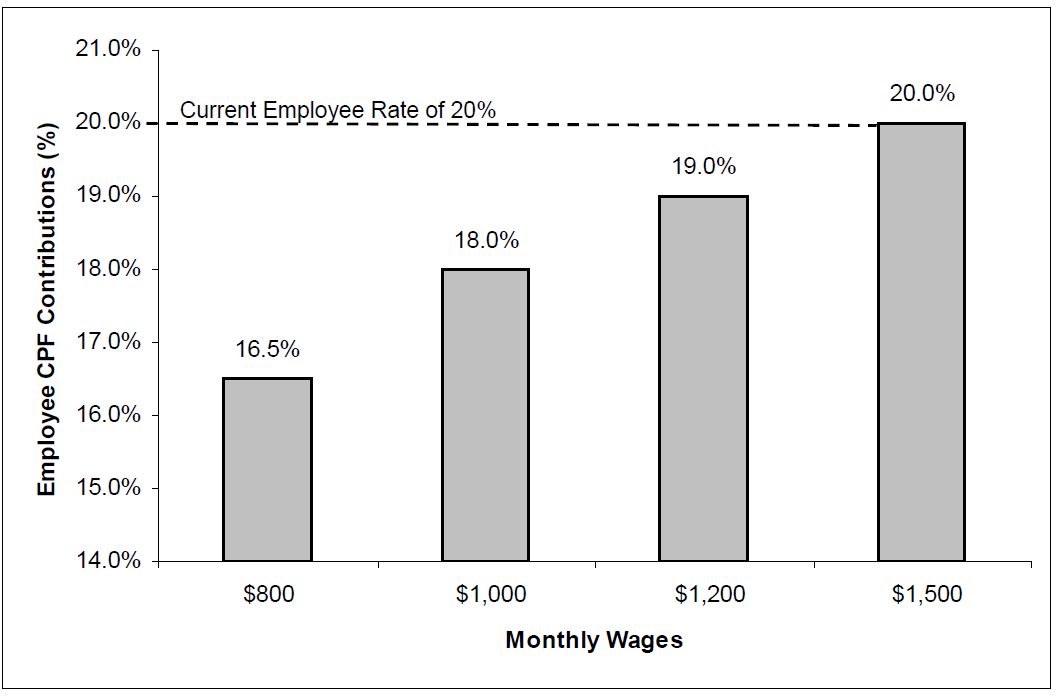
(2)
Increase Employability of Older Low-Wage Workers
- Reduce the employer component of CPF contribution rates for
workers above 35 years old and earning $1,200 or less.
- Increase employer CPF contributions gradually from 0% at a monthly
wage of above $50 up to 13% at a monthly wage of $1,200. The 1.5% increase
in CPF will be phased in between $1,200 and $1,500. (Employers currently pay the full rate
of 13% when monthly wages exceed $50.)
- Example: The employer of a 40-year old worker earning $900 per
month will now pay $20 less in employer CPF contributions for the worker.
- Figure 2 summarises the change in employer CPF
contributions for those aged above 35 to 50.
- The rates for employees above 50 years old will be scaled down
accordingly.
Figure 2: Employer CPF
Contribution Restructured
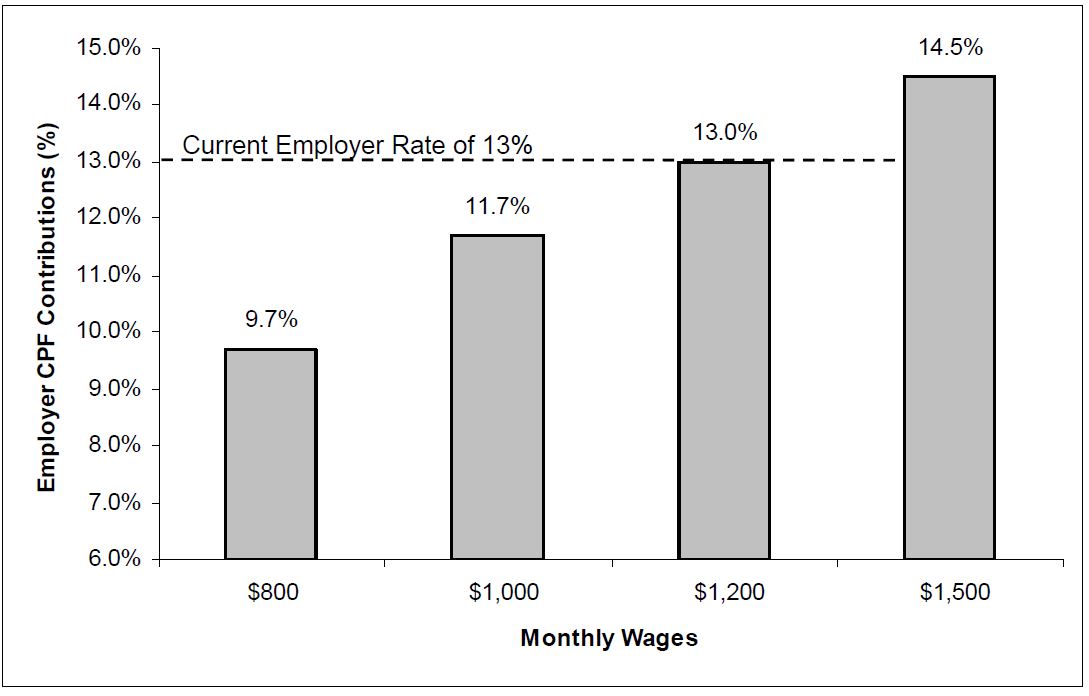
(3)
Help Self-Employed Persons (SEPs) contribute to CPF
- Reduce the Medisave contribution rate to one-third of the full
rates i.e. less than 3% for those with an annual net trade income of above
$6,000 and up to $12,000. The contribution rate will gradually rise to the
full rates for those with an annual net trade income of between $12,000
and $18,000.
- SEPs earning an annual net trade income of $6,000 or less do not
have to contribute to the CPF. But those who meet the Workfare Income
Supplement (WIS) scheme criteria can voluntarily contribute at the reduced
contribution rates to qualify for WIS.
Workfare Income Supplement (WIS) Scheme for Older Low-Wage Workers
Eligibility
Criteria
- Singapore Citizen;
- Monthly salary of $1,500 or less;
- Above 35 years old;
- Stays in a property of not more than $10,000 annual value; and
- Works at least three months in any six-month period in the calendar
year, or at least six months in the calendar year.
Payout
Structure
- Payouts will be given to
eligible beneficiaries earning above $50 and up to $1,500 a month.
- Higher payouts for those
above 45 years old, up to a maximum of $1,200 a year.
- Maximum of $900 a year
for those aged above 35 to 45.
- For employees, the WIS
will be paid with a cash-to-CPF ratio of 1 : 2.5.
- Payments will be made
twice a year.
- Eligible workers who have
worked for at least three months in the first six months of 2007 can look
forward to their first payout in January 2008.
Self-Employed Persons and Informal
Workers Need to Make Medisave Contributions to Benefit from WIS
- Self-employed persons and
informal workers who meet Workfare eligibility criteria will be required
to contribute into their Medisave Accounts (MA) in order to receive
WIS.
- WIS
for self-employed persons and informal workers will be two-thirds of the
amount for employees, as they contribute much less in CPF. The WIS
will be paid entirely into their MA.
- Figure 3
illustrates an example of a 46 year-old self-employed worker who earns
$1,000 per month, and receives $67 of WIS
payouts to his MA.
- Self-employed and informal
workers who earn $6,000 or less in annual net trade income can make
voluntary contributions to qualify for WIS.
Figure 3: Example of 46 year-old Self-Employed Worker Earning $1,000
/ month
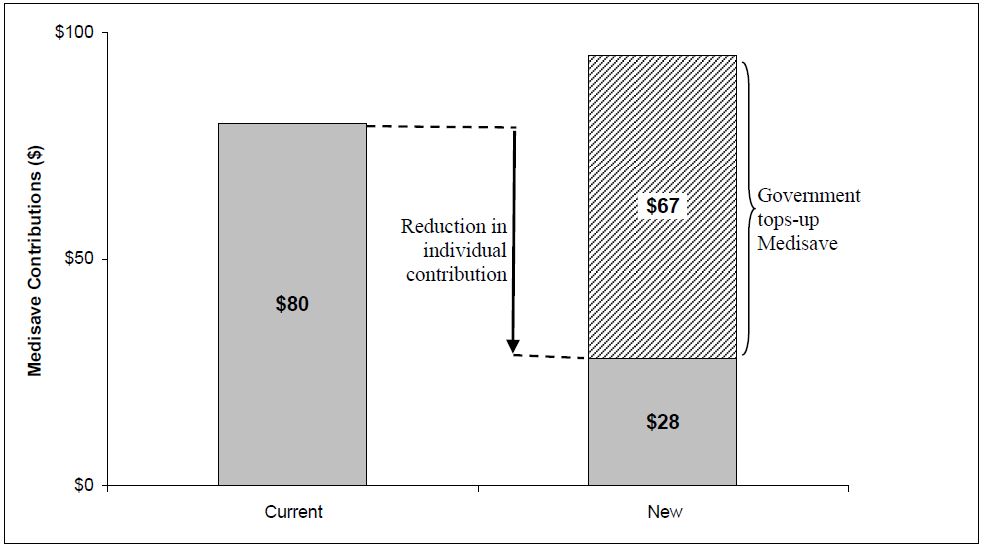
Overall
Impact of WIS and
CPF Changes
- WIS
is designed to complement the CPF changes.
- The reduction in CPF
contributions from the CPF changes will in general be made up for by WIS.
- Beneficiaries will be
better off as compared to previously.
- Low-wage workers will be
better off as compared to previously.
- Employers will enjoy
savings from hiring these workers.
Table 1: Illustration of Impact of WIS and CPF changes
A
46-year old employee earning $800 per month
|
|
Current ($)
|
New ($)
|
Difference ($)
|
|
Employee CPF
|
160
|
132
|
-28
|
|
Employer CPF
|
104
|
77
|
-27
|
|
WIS Cash (monthly)
|
-
|
29
|
29
|
|
WIS CPF (monthly)
|
-
|
71
|
71
|
|
Take-home Pay
|
640
|
697
|
57
|
|
Total CPF Contributions
|
264
|
280
|
16
|
|
Total Income
|
904
|
977
|
73
|
|
|
|
Employer Savings ($)
|
27
|
|
Total WIS ($)
|
100
|
A
46-year old employee earning $1,000 per month
|
|
Current ($)
|
New ($)
|
Difference ($)
|
|
Employee CPF
|
200
|
180
|
-20
|
|
Employer CPF
|
130
|
117
|
-13
|
|
WIS Cash (monthly)
|
-
|
29
|
29
|
|
WIS CPF (monthly)
|
-
|
71
|
71
|
|
Takehome Pay
|
800
|
849
|
49
|
|
Total CPF Contributions
|
330
|
368
|
38
|
|
Total Income
|
1,130
|
1,217
|
87
|
|
|
|
Employer Savings ($)
|
13
|
|
Total WIS ($)
|
100
|
A
46-year old self-employed with an average net trade income of $1,000 per month
(or $12,000 per year).
|
|
Current ($)
|
New ($)
|
Difference ($)
|
|
CPF Contributions
|
80
|
28
|
-52
|
|
WIS CPF (monthly)
|
-
|
67
|
67
|
|
Takehome Pay
|
920
|
972
|
52
|
|
Total CPF Contributions
|
80
|
95
|
15
|
|
Total Income
|
1,000
|
1,067
|
67
|
|
|
|
Total WIS ($)
|
67
|
ANNEX C: SME Rebate Scheme
The SME Rebate Scheme
will last two years. Rebates will be
paid to qualified firms on an annual reimbursement basis after the end of each
12-month qualifying period. The start of
the first qualifying period will coincide with the increase in CPF contribution
rate (1 July 2007). The two
qualifying periods will hence be:
·
1 July 2007 to 30 June 2008 (“first year”)
·
1 July 2008 to 30 June 2009 (“second year”)
After the end of each qualifying period, CPFB will
make payment to firms based on their total CPF payment for that period.
The rebate is pegged to
total employer and employee contributions payable by a firm to CPF Board. The rebate is 2% of the first $40,000 of
total CPF contribution and 1% of the next $40,000 of total CPF contribution in
the first year, and at 1% and 0.5% respectively for the second year.
|
|
First Year
(01 Jul 07 – 30 Jun 08)
|
Second Year
(01 Jul 08
– 30 Jun 09)
|
|
1st Tier
|
2% of first $40,000
of total CPF contribution (max $800)
|
1% of first $40,000 of total CPF contribution (max $400)
|
|
2nd Tier
|
1% of next $40,000
of total CPF contribution (max $400)
|
0.5% of next $40,000 of total CPF contribution (max
$200)
|
To receive the rebates,
firms will have to apply to CPF Board and declare that they meet the SME
qualifying criteria. Further details of
the application process and eligibility criteria will be released by 1 May 2007.
ANNEX D: New Customs and Excise Duties for Beer and
Stout
|
HS code
|
Product Description
|
Current Duty Rates
|
New Duty Rates
|
|
Customs Duty
|
Excise Duty
|
Customs Duty
|
Excise Duty
|
|
22030010
|
Stout & porter
|
$1.70 per litre
|
$3.70 per litre
|
$16 per litre of alcohol
|
$48 per litre of alcohol
|
|
22030090
|
Beer & ale
|
$0.80 per litre
|
$2.70 per litre
|
$16 per litre of alcohol
|
$48 per litre of alcohol
|
|
|
HDB
1 Room
|
HDB
2 Room
|
HDB
3 Room
|
HDB
4 Room
|
HDB
5 Room
|
HDB
Exec
|
Private Houses and Flats
|
|
Annual Household Income from work ($) 1
|
7,630
|
13,220
|
32,770
|
48,840
|
71,160
|
90,510
|
140,200
|
|
Additional GST Payable Annually ($) 2
|
240
|
320
|
500
|
690
|
870
|
1,030
|
1,090
|
|
Total Benefits from GST Offset Package
(over 5 years) ($) 3
|
3,880
|
4,110
|
3,940
|
4,030
|
3,750
|
3,550
|
1,590
|
|
Number of Years of Additional GST
Payable that is offset by the GST
Offset Package
|
19
|
16
|
10
|
7
|
5
|
4
|
2
|
ANNEX E: Impact of GST Offset Package on Households
Notes:
1) Household incomes are estimated based on the 2005
General Household Survey conducted by the Department of Statistics (DOS) and
comprises employment and business income only.
It does not include income from other sources such as rental,
investments, pensions and irregular or extra-ordinary receipts.
2) Additional GST payable annually, from the increase
in GST rate from 5% to 7%, is estimated based on the household expenditure
estimates from the 2002/03 Household Expenditure Survey (HES) conducted by DOS.
3) Includes only GST Credits, Senior Citizens' Bonus,
U-Save rebates, service & conservancy charges rebates, rental rebates,
property tax rebates and Post-Secondary Education Account (PSEA) top-ups.
ANNEX F: Budget for FY2006 and FY2007
|
|
Revised FY2006
|
Estimated FY2007
|
Change over
Revised FY2006
|
|
|
$billion
|
$billion
|
$billion
|
%
|
|
OPERATING REVENUE
|
30.00
|
32.36
|
2.36
|
7.9
|
|
Corporate Income Tax
|
8.25
|
8.40
|
0.15
|
1.9
|
|
Personal Income Tax
|
4.68
|
5.16
|
0.48
|
10.2
|
|
Statutory Boards’ Contributions
|
0.96
|
1.36
|
0.41
|
42.6
|
|
Assets Tax
|
2.03
|
2.09
|
0.06
|
2.8
|
|
Customs and Excise Taxes
|
1.95
|
1.96
|
0.01
|
0.4
|
|
Goods and Services Tax
|
3.93
|
4.85
|
0.92
|
23.4
|
|
Motor Vehicle Related Taxes
|
1.65
|
1.74
|
0.09
|
5.7
|
|
Vehicle Quota Premiums
|
0.08
|
0.26
|
0.18
|
240.4
|
|
Betting Tax
|
1.57
|
1.62
|
0.05
|
3.0
|
|
Other Taxes
|
2.81
|
2.83
|
0.01
|
0.4
|
|
Other Fees and Charges
|
1.95
|
1.94
|
(0.01)
|
(0.7)
|
|
Others
|
0.14
|
0.16
|
0.01
|
10.5
|
|
|
|
|
|
|
|
Less:
|
|
|
|
|
|
TOTAL EXPENDITURE
|
30.55
|
33.00
|
2.45
|
8.0
|
|
Operating Expenditure
|
24.43
|
25.88
|
1.45
|
5.9
|
|
Development Expenditure
|
6.12
|
7.12
|
1.00
|
16.4
|
|
|
|
|
|
|
|
PRIMARY SURPLUS/(DEFICIT)
|
(0.55)
|
(0.64)
|
|
|
|
|
|
|
|
|
|
Less:
|
|
|
|
|
|
SPECIAL TRANSFERS
|
3.58
|
2.07
|
(1.51)
|
(42.1)
|
|
GST Credits
|
-
|
0.53
|
|
|
|
National Research Fund
|
0.50
|
0.50
|
|
|
|
Workfare Income Supplement Scheme
|
-
|
0.20
|
|
|
|
Top-ups to Post-Secondary Education Account
|
-
|
0.20
|
|
|
|
U-Save Scheme
|
0.06
|
0.15
|
|
|
|
Senior Citizens’ Bonus
|
-
|
0.10
|
|
|
|
S&CC and Rental Rebates
|
0.04
|
0.08
|
|
|
|
Other GST offset measures@
|
-
|
0.01
|
|
|
|
Growth Dividends
|
1.37
|
-
|
|
|
|
Top-ups to CPF Accounts
|
0.48
|
-
|
|
|
|
Workfare Bonus Scheme
|
0.40
|
-
|
|
|
|
40th Anniversary NS Bonus
|
0.20
|
-
|
|
|
|
Economic Restructuring Shares
|
0.08
|
-
|
|
|
|
Top-up to Opportunity Fund
|
0.05
|
-
|
|
|
|
Top-up to ComCare Fund
|
0.10
|
-
|
|
|
|
Top-up to Medifund
|
0.10
|
0.20
|
|
|
|
Top-up to ElderCare Fund
|
0.10
|
-
|
|
|
|
Top-up to Lifelong Learning Fund
|
0.10
|
0.10
|
|
|
|
|
|
|
|
|
|
Add:
|
|
|
|
|
|
NET INVESTMENT INCOME CONTRIBUTION
|
2.84
|
2.02
|
(0.83)
|
(29.0)
|
|
OVERALL BUDGET SURPLUS/(DEFICIT)
|
(1.28)
|
(0.69)
|
|
|
A
financial institution refers to any institution licensed or approved by the
MAS, or exempted from such licensing or approval under any Act administered by
the MAS, and includes an institution approved as a Finance and Treasury Centre
under Section 43G of the Income Tax Act (Cap 134).